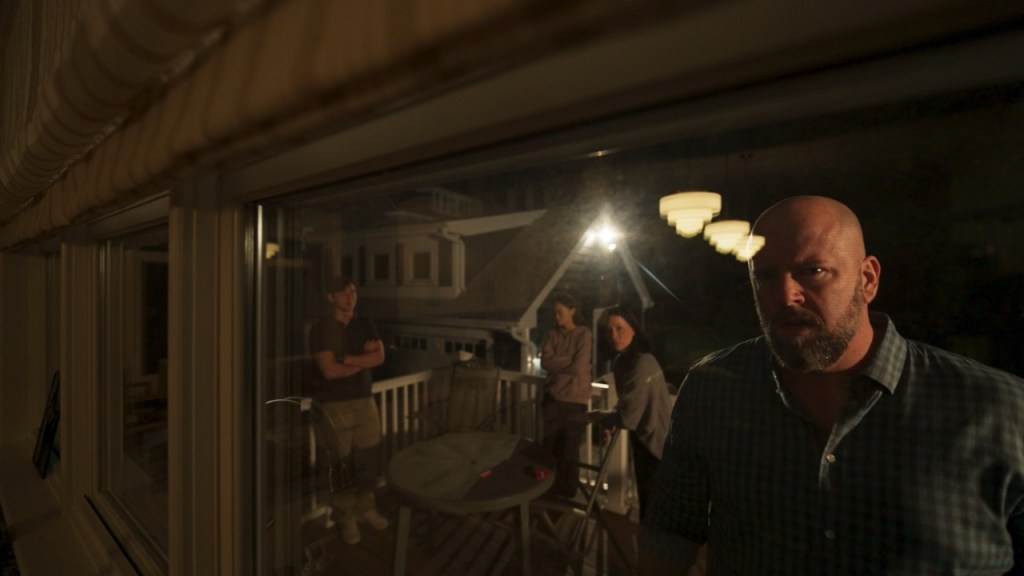
Forget presence; a more apt title for Steven Soderbergh’s latest feature film would be perspective. The word can’t help but come to mind during the opening shot, a roving, silent long take that inspects the rooms and outside environments of an empty home in suburban New Jersey, but its utility stretches beyond the literal or immediate. A dread-inducing sense of voyeurism floods the screen to its very corners, the audience unwittingly thrust behind the eyes of an unseen stalker, but has anyone watching a movie ever been less than an interloper? Most everyone tacitly agrees that the things we intellectually ingest through sound, sight, or interpretation have the capacity to change us. Presence doesn’t have to utter a syllable to suggest that the relationship is a bit more reciprocal than is comfortable to admit.
The words do come, provided by the Paynes family, the nuclear unit who takes up residence in the shadowy abode. Comprised of bread-winning mother Rebekah (Lucy Liu), perceptive father Chris (Chris Sullivan), star athlete son Tyler (Eddy Maday) and emotionally cloistered sister Chloe (Callina Liang), the foursome adhere to the archetypal shape of the standard American brood, which is to say they’re a mess. The niceties they likely present in the larger community might mask their deficiencies, but are powerless against the nameless poltergeist that roams the house, listening in on private conversations and witnessing moments of interpersonal turmoil. Having unlimited access to their daily soap opera would seem like enviable entertainment for an invisible phantom, but one can only stand back and watch for so long before intervention becomes necessary. The Paynes have a tendency to find themselves in harm’s way, the transparent vector being the least of their concerns.
Unwilling to let the film’s high concept proposition (a ghost story told from the vantage point of the apparition) stand as the only narrative enticement, screenwriting veteran David Koepp lays on the melodrama in thick, sinewy globs. More Tennessee Williams than Paranormal Activity, Presence introduces each of its characters at a calamitous inflection point, investing in their strife in a manner that feels distinctly more stage-bound than your average genre exercise. It’s a curious calculation, placing equal weight on high school bullies and investment fraud as it does the unseen force that haunts the halls, but providing spine-tingling thrills was never the goal in the first place. Presence is about the power the observer holds over the observed. Thankfully, the cast is worthy of our full attention, even when their one-sided depiction is not.
Liu finds herself on the wrong side of Koepp’s surprisingly moralistic approach, reduced to a background player by virtue of both fiscal misdeeds and a regrettable fondness for her scourge of a son. The scribe’s sympathies clearly reside with Chris, and while it’s wise to be skeptical of any part that’s written with such preferential treatment, Sullivan’s gravely gravitas is worthy of the spotlight. Like a beleaguered Jimmy Stewart or a roughneck Gregory Peck, the actor’s rugged exterior wrongfoots the audience before his soft-spoken grace takes hold, a slight of hand that could easily go sideways with a different performer in the role. He’s a revelation, though this magnetism extends to Liang, whose deteriorating Chloe provides the movie with its aching heart. That Presence bends so dramatically in their favor is surely a result of Soderbergh being drawn to their sterling work while holed up in the editing bay, but it’s not the only reason. After all, cinema is a magic track, and the camera tends to find the believers.
Chloe is the first to notice, the realization dawning on her slowly, implied only through the actor’s expressions and movements. The rest of the family is forced to reckon with their situation as the evidence starts to mount, but the property damage and light switch chicanery only frightens those within the picture. For the audience, it’s the Paynes who play the sinister antagonists, if only for wordlessly calling out our overzealous prying. The innumerable moments in which characters stare directly into the camera, whether from across a crowded room or through face-to-face close-ups, feel like being caught in the act of spying, a queasy-making cocktail of fear and guilt churning in the pit of your stomach. It would be quite the stretch to call Presence as a true horror movie, but the goosebumps produced by being so directly confronted, experiencing the unspoken contract between the watchers and the watched being torn to shreds, are more spine-tingling than those prompted by most standard terror outings. The lens is supposed to serve as a shield of sorts, but behind Soderberg’s camera, safety is never a given.
Yes, it’s the Oscar-winning director who’s shooting everything that we witness, albeit under the pseudonym Peter Andrews, though his extracurriculars don’t stop there. In addition to his role as director, Soderbergh also acts as cinematographer and editor on a film that somehow represents his 35th feature offering. That’s a head-spinning level of productivity, especially from a guy who announced his retirement back in 2013, only to have helmed nine flicks thereafter, not to mention an avalanche of television. You get the impression that this DIY approach, as well as working at a lower production budget and thereby with fewer benefactors to please, awakened his creativity.
Or maybe love of problem solving is more accurate, as each new entry into Soderbergh’s filmography feels more like an architectural puzzle than the last, a challenge to do more will less, often within the confines of genre. Making something just to prove you can isn’t ideal, and there have been points over the years where the how has managed to overtake the why, but hand-cuffed construction here is a glorious instance of form following function. The fourth wall is more comforting than the other three combined, and by sliding it in and out of place, Presence posits that we’re just as involved in the goings-on as their ostensible participants. It’s one thing for reality tv or live televised events to drill down on this thesis, but another entirely to see it weaponized on the big screen. By the time the credits roll, it’s hard to shake the feeling that you might have concealed company of your own.
 Sherwood Likes to Watch
Leave a comment