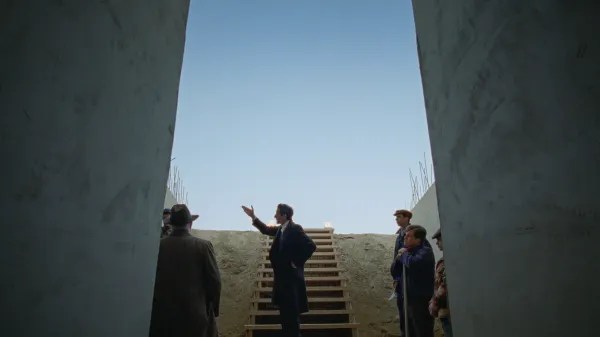
Is there any better description of a movie than that of its construction? Paraphrasing László Tóth in this manner would likely strike The Brutalist’s titular figure as a bit gouache, but if Brady Corbet disagrees, he’s kidding himself. Now seven years removed from the perceived studio mismanagement of his previous feature, 2018’s Vox Lux, the director’s latest is pain-stakingly designed to endure the whips and scorns of time, critics and financiers alike. Built like a fortress with eyes on deterring intruders, the film’s 214 minute runtime is a perfect distillation of form following function; if you want your magnum opus to stand proudly in the tradition of cinematic titans like The Godfather saga or Once Upon a Time in America, it’s best to act like you belong. There are no half-measures when it comes to willfully inviting yourself into the American canon, an understanding that The Brutalist embodies with its every waking motion.
It is, after all, a movie of movements, opening with an overture before spreading out into two separate acts that are divided by an intermission, a prologue arriving in their wake. They concern the aforementioned Tóth (Adrien Brody), a Hungarian Jew who’s just escaped the Holocaust when we meet him, emerging from the darkened bowels of a massive ship to touch U.S. soil, an upside-down Statue of Liberty serving as a leering greeting committee of one. Finding constrained work at his cousin’s furniture store, the architect’s unmistakable brilliance eventually catches the eye of Harrison Van Buren (Guy Pearce), an industrialist-cum-socialite who knows a mutually beneficial relationship when he sees one. Commissioned to design and erect a local community center in Van Buren’s late mother’s honor, Tóth finds himself emphatically thrust into his benefactor’s version of the American dream, with all its soaring highs and deplorable lows waiting in the wings.
Drawing a clear point of comparison between mass genocide and the perils of working in tinseltown is morally dubious to say the least, but Corbet isn’t interested in compromises. Co-written by his wife and fellow filmmaker Mona Fastvold, The Brutalist’s screenplay may project years of research and historical realism onto its vast canvas, but the painting itself is deeply reflective, a testament to its maker’s sky-scraping ambition. That Corbet likens himself to a master constructionist is never in doubt, and neither is the hurt he obviously still carries from years of seeing his vision compromised by those with deeper pockets but shallower foresight. From a technical standpoint, his self-appraisal is impossible to deny.
Resurrecting a long-dormant form of technology, as Corbet and cinematographer Lol Crawley do here by shooting in VistaVision, is a sure-fire way to attract cineist attention, but it’s also in keeping with the subject matter. The purported intention (to place viewers in the time and place of the film by using contemporaneous lensing) would only make for a nice quote if it didn’t positively obliterate its target. There’s simply no overstating The Brutalist’s optical grandeur, the enveloping hues of its color palette, the tactile realization of the faces, settings, and implements it presents. As if it needed bolstering, with resplendent barrage of comely sights is set to Daniel Blumberg’s gobsmacking score, an ocean of stings and horns meticulously mounted to convince the viewer that they’re in the presence of greatness.
Those in need of further persuasion will find supplemental proof in the form of the movie’s slew of head-spinning performances. Brody is the clear headliner, his multifaceted turn here calling back to his Oscar-winning part in The Pianist over two decades ago, but obviousness shouldn’t negate the accomplishment. Present in nearly every frame, the actor’s mix of evident brilliance, lingering agony, and taciturn disdain makes Tóth knowable even while the script purposely keeps its central figure at arm’s length, with clarity on his outlook and motivations only arriving in the final frames. Van Buren’s goals are much less murky, but Pearce’s work shouldn’t be dismissed on the grounds of its clear-eyed intention. Wearing the glamour and affectations of late-period Brad Pitt as though they belong to him alone, his character is a gloriously-rendered manifestation of old money self-importance, carefully fitted with all the forward-facing generosity and deep-seeded resentment that it implies. Felicity Jones, who enters the frame in the flick’s back half as László’s long-lost wife Erzsébet, is less convincing, but Amy Adams’ shoes are a lot to fill.
Likening her role to that of Adams’ in The Master is just the tip of the iceberg when it comes to aligning The Brutalist with Paul Thomas Anderson’s inscrutable 2011 masterpiece. The camera work pays similar homage, as does the movie’s side-door treatise on post-World War II America, its rebirth viewed through the fits and starts of outsiders seeking refuge in a country still in search of its own definition. Anderson is a more intuitive filmmaker, able to follow his whimsy while keeping his singular tonal frequency in check, and whatever faults one finds in The Brutalist are easily chalked up to Corbet’s fealty to the wrong modern paragon. The drug use and psycho-sexual themes here feel borrowed from a stranger offering, clashing with the classicism that orients everything around them. With the rest of the movie neatly slotting into our shared understanding of the yesteryear epics, Corbet might have been better off leaving the contemporary world at bay, following his protagonist’s aversion toward assimilation.
Rather than capitulating to your standard cut out of all-consuming devastation, Brody plays Tóth with a chip on his shoulder the size of a canyon, regarding the reflexive bend of his fellow countrymen toward nationalistic integration with simmering contempt. The pride and derision are novel within this framework, Tóth constantly chafing against his own victimization, unwilling to allow tragedy to overshadow his enviable gifts. This, again, is conspicuously metatextual, with Corbet wagering that his own foolish benefactors will see the light only if he can make something bright enough to blind them. Using Jewish persecution to get his point across will likely prove too unethical for some audience members to abide, but like Tóth himself, the helmer’s belief in the ability of his raw tools to manufacture something capable of standing up to scrutiny is well founded.
Mounted with a comparatively sparse budget of 10 million dollars, The Brutalist smashes minimalism and maximalism together until something beautiful is formed. Its disparate parts don’t always sync up, but the towering edifice is more important than the rooms therein. The occasional failures cower at the feet of towering splendor, with scenes involving a hilltop professional appointment and a trip to a magisterial marble quarry staunchly embossing their place in movie history upon first encounter. Anderson wasn’t messing around when he named The Master in his own image, and neither is Corbet. The former is a leader of men capable of turning the universe inside out until it matches his mind’s eye, while the latter makes a beeline toward immortality by deftly fitting to its shape. The closing remarks of another player make The Brutalist’s point loud and clear, and there’s no need to paraphrase this time around: No matter what the others try and sell you, it is the destination, not the journey.
 Sherwood Likes to Watch
Leave a comment