Most discussions that swirl around long-standing institutions and their capacity for change are just wasted breath, but the Academy actually did the damn thing. After years of declining viewership and an unpopular sliding scale of Best Picture nominees, the nearly century old Hollywood bellwether has settled into a new era. While faintly manifested in a slew of category and rule switch-ups, the most important modification is the broadening of the voting body, especially where international film lovers are concerned. Conventional understanding of what is and isn’t an ‘Oscar movie’ has essentially gone out the window, with oddball winners like Everything Everywhere All At Once and unthinkable nominees like The Substance reaping the benefits. Foreign flicks have enjoyed a similar boost, with at least one non-English feature making the final cut every season since the pool for the night’s top prize was widened to include ten combatants in 2021. It may all read like No Country For Old Awards Bait, but the golden man hasn’t fully lost his appetite for traditional awards season fare. It’s just been outsourced.
Suggesting that I’m Still Here was created with stateside plaudits in mind is laughable, but one gets the feeling that ballot casters greeted it as a breath of shelf stable air. Us Americans were too busy chronicling Russian immigrant strippers and taking POV tours through the Jim Crow south to give more traditional narratives much thought, providing an opening for Brazilian director Walter Salles to crash the party with something welcomely familiar. Flicks that chart moments of historical upheaval are certainly a known cinematic quantity, especially when filtered through the microcosmic lens of a human interest story, and I’m Still Here, set amidst the dawn of Brazil’s 20 year military dictatorship in 1970, fits both bills to a tee. Throw in a steely, committed lead performance from an underappreciated industry stalwart, and the trophies will surely follow… if we still lived in the 90’s.
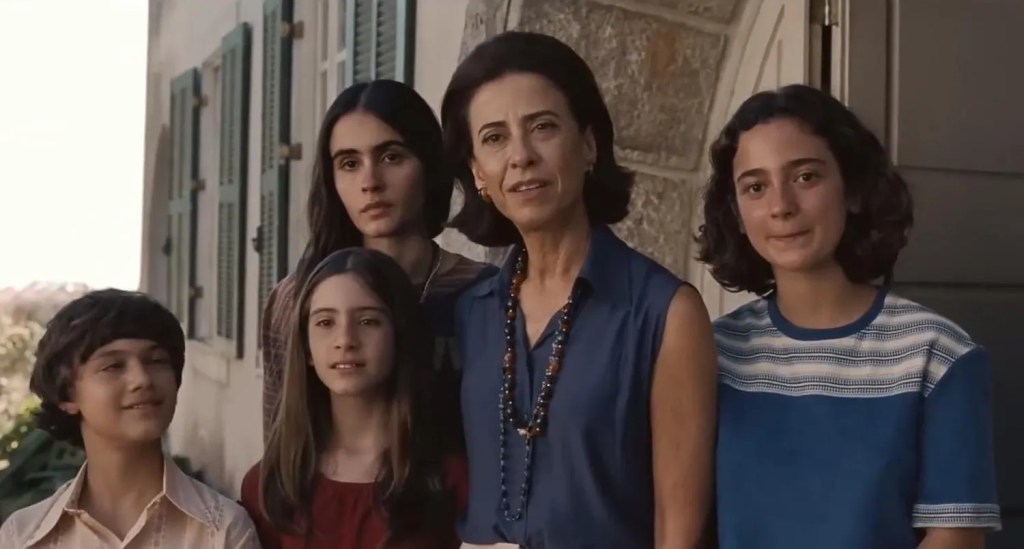
The aforementioned actor is Fernanda Torres, embodying real-life civil rights activist Eunice Paiva in an adaptation of her son’s 2018 memoir, which shares its name with the film. The soft-spoken matriarch of the Paiva clan has her breezy, sunkissed existence thrown into disarray when husband and father Rubens (Selton Mello) is taken from their home by government officials with precious little pretext. Eunice’s subsequent protestations land her in a dark and dingy holding cell for nearly two weeks, but the brief imprisonment has the opposite of its intended effect, setting our heroine off on a quest of discovery while watchful eyes bear down from every angle.
Their subjects and surfaces could hardly be more divergent, but the fellow 2024 Best Picture nominee that shares the most DNA with I’m Still Here is A Complete Unknown, another handsomely, humbly mounted effort that compellingly argues in favor of the tried and true. The latter comforts and coddles while the former seeks to engage and enrage, though the ease with which each accomplishes their goal is baked into their respective material. Injustice and celluloid go together like peanut butter and jelly, and only the most jaded of viewers will find themselves unmoved by the Paiva family’s dastardly plight and ultimate resolve. The ceiling is only so high when working within such well-charted territory; it’s the floor that stands to benefit.
That isn’t to say that Here simply rests on its atrocities. Salles might not be a showman in the mold of most world cinema luminaries, but his grip on tension is iron-clad, capable of masking the relative inertia of the movie’s second half. His reticence to get in the way of a story that doesn’t need a finger to tip the scale is shared by cinematographer Adrian Teijido, whose sweaty handheld interludes are as close as this one comes to having genuine style. It’s a point-and-shoot affair, but the cornucopia of colors, sounds, and movement provided by daily life in Rio de Janeiro conjure an aesthetic that doesn’t necessitate further bolstering. You can get away with less when a ripped-from-the-headlines yarn brings the more, especially when the players are so deftly chosen.
Torres, who followed Here to Oscar glory with a Best Actress nomination, hews carefully to the film’s overarching minimalism, her largely stayed, interior performance judiciously parcelling out simmering frustration and piercing devastation, saving their impact from dilution. Mello is no less wonderful for being one-dimensional, embodying the familial warmth and closeness that the movie’s opening half hour prioritizes as a ruthless means of wrongfooting. The frenzied living room parties and idyllic beach bum outings of the first act serve as ballast for the calamity that’s soon to follow, cherishing good times in the moment rather than extolling virtues in their wake. By the 2014 setting of the film’s conclusion, the distance between starting and ending points feels both vast and earned, a living document powered by ample reserves of remembrance and nostalgia.
Salles knows a thing or two about conflating the past with the present in real time, having worked as a producer on 2002’s City of God, the last Brazilian import to garner this much stateside attention. Like director Fernando Meirelles’ film, I’m Still Here cinches its backward-looking affectation by placing a camcorder in the hands of one of its characters, offering an on-the-ground observation of innocence lost, minute by minute. This harkening back to better and brighter days synergizes with the film’s elemental stakes and presentation, coalescing into a hard won assertion that the good old days are still available to us, should we so choose to indulge them. I’m Still Here is the theater of nuts and bolts, as unsurprising as it is fulfilling. If it was good enough for Aeschylus, it’s good enough for us.
 Sherwood Likes to Watch
Leave a comment