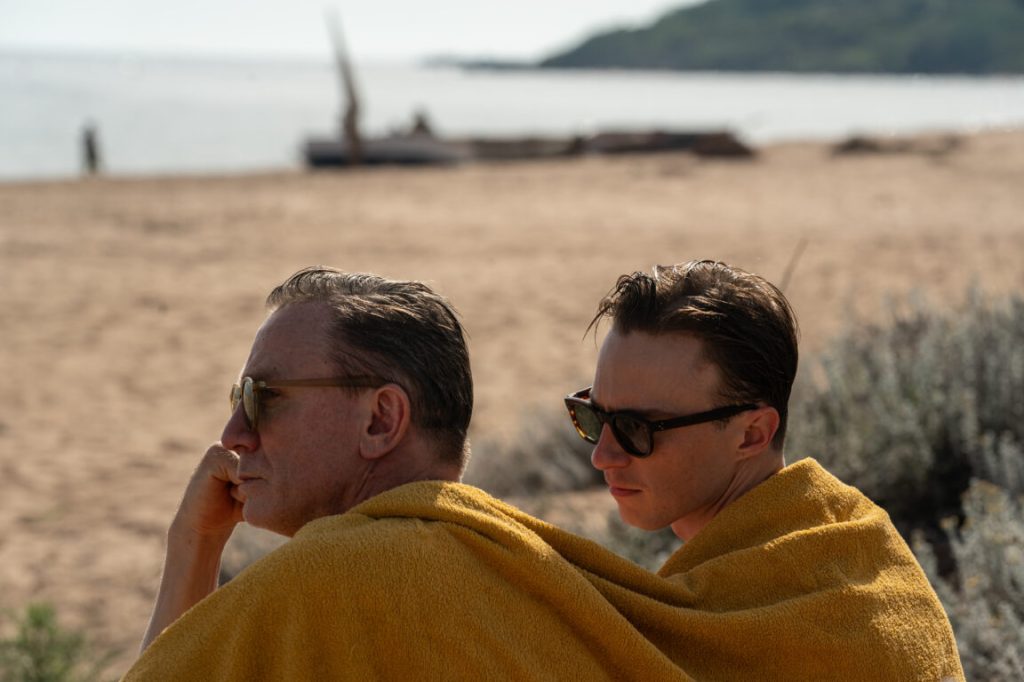
As iron sharpens iron, so each will tease the inner freak out of the other. Regardless of how one feels about the recent work of Luca Guadagnino, his career’s certainly not losing steam. Riding high off the success of Challengers, the Zendaya-starring sexy tennis flick that stands as his biggest box office hit to date, itself arriving in the wake of Timothée Chalamet vehicle Bones and All, the Italian auteur’s hot streak almost demands a curveball. The same goes for Daniel Craig, who’s used his winsome work in the Knives Out franchise to convert his onscreen persona from icy-eyed symbol of masculine excellence to lovable court jester. Playing to the cheap seats doesn’t mean the erstwhile James Bond can’t still get weird with it, just as Guadanino’s time casting Hollywood’s brightest young stars in golden light hasn’t permanently negated his naughtier, knottier interests. They’ll both be heading back to safer shores soon, so let’s take a moment to celebrate Queer, a film that happily luxuriates in its title’s dual meaning.
Though never straying away from our contemporary understanding of the titular word, Guadagnino’s latest is equally attuned to its former usage, spinning a yarn that’s as adverse to conventional structure as it is keen to revel their abandonment. Adapted from a William S. Burroughs’ 1985 novella of the same name, Craig stars as William Lee, an American expat in a 1950’s Mexico City whose drinking, drug use, and casual sex takes Hemmingway’s movable feast to its dastardly conclusion. Into this debaucherous existence walks Eugene Allerton (Drew Starkey), a fellow out-of-countrier whose very visage begets instantaneous infatuation. The feeling isn’t quite mutual, and Queer, in all its plot-eschewing nonchalance, follows the narcotics-enhanced push-pull between a pair of lovers, one mercilessly tossed about in the throes of passion while the other remains ambivalent, if not downright aloof.
That Allerton feels so nebulous and intangible is by no means an accident; his admirer is too overcome with lust to take stock of his desire’s personality whatsoever. Initially reading as a glaringly underwritten character, the abstruse nature of Lee’s quasi-paramore is the most glaring proof of our protagonist’s unreliability as a narrator. It’s certainly not the only evidence, with the movie’s pointedly artificial establishing shots, often involving model cars traversing miniature cityscapes, placing us firmly in a fever dream headspace. Those looking to dock points for the film’s use of Cinecittà Studios in Rome as a ill-fitting stand-in for Mexico’s capital are missing its untrustworthy intentions, though anachronistic soundtracking selections from the likes of Prince, New Order, and Nirvana ought to guide them back onto the road.
Lee won’t be joining them there, too subsumed in a life of dreary excess to forge a paradigm with any real coherence. He’s an ugly person drifting through an ugly existence, and Craig brings him to life without the slightest whiff of knowing vanity. Sweating and fidgeting with an itch that feels bone deep, the actor doesn’t renounce Benoit Blanc’s physical mannerisms so much as repurpose them, newly employed as markers of a man torn asunder by addiction. He’s a car crash you can’t look away from, and for all the performance lacks in subtlety, the riveting, nausea-inducing calamity of it all is a sight to see. Starkey can only stand back and watch for fear of being burned by his co-star’s wildfire, and while his placid remove is required for the role, the vacancy likely worked better on page than it does on screen. Given all the fun Craig has jostling back and forth with a wonderfully rapscallion Jason Schwartzman, one wishes the flick had found a way to manufacture some chemistry between its two leads.
It wouldn’t have to be sexual in nature, though Guadagnino’s salacious presentation here certainly prepares the space. A filmmaker once associated with sensuous tactility and dog-in-heat arousal, the lingering effects of Luca’s detour into body horror are only now starting to fade. Queer’s frequent and unabashed sex scenes are a step in the right direction for those who have found cinema at large a bit too chaste of late, but their undergirding of filth and misery withholds any real sense of pleasure. Perhaps finding joy in seedy copulation would undermine the film’s grimy, greyed-out netherworld, but then why have Lee’s first glance of Allerton take place over an ongoing cock fight? The pleasure seeker is still in there, making middle school dick jokes in lieu of crafting something genuinely steamy.
There’s no real use in wishing that a film would contort to interests outside of its own, and Queer’s are more metaphysical than corporeal, even in a logistical sense. There’s no other explanation for the movie’s galaxy-brained final act, which sees Lee and Allerton cross paths with an unrecognizable Leslie Manville deep in the Ecuadorian jungle. How we get there is less important than the psychedelic satisfaction of watching a flick blissfully go off the rails, and the ayahuasca-induced hallucinations that greet us at the end of the rainbow are both haunting and ravishing enough to justify the journey. Just when you think we’re done tripping headlong down the rabbit hole, Guadagnino ushers in an epilogue that’s more indebted to 2001: A Space Odyssey than any sane person would have previously thought him capable of conveying. He’s no Kubrick, but no one is. It’s best to just enjoy the ride.
Locating its meaning is a bit trickier, though a longing for connectivity in an ever-expanding world certainly guides the expedition. Justin Kuritzkes’ screenplay doesn’t offer enough insight into Lee’s original wounds for all the unspoken pain to hit its mark, but Queer is best enjoyed on a sensory level anyway. As a fearless plunge into a hazy mind’s broken paradigm, it works like gangbusters, and offers both Guadagnino and Craig an inviting playground on which to explore their unhinged flights of fancy. It’s an odd duck, likely to prompt more tentative viewers to tap out midstream, but those looking for something off the filmic beaten path would be remiss to let it pass by without notice. Just don’t expect anyone on hand to behave themselves, rationally or morally. Those qualities are for squares, and in Queer, there’s not a right angle in sight.
 Sherwood Likes to Watch
Leave a comment