1984 might still be the seminal George Orwell text, but Animal Farm is certainly gaining ground. The 1945 novella, a staple in middle school English classes across the US, has a staying power all its own, but perhaps its greatest legacy is in the field of adaptability. Anthropomorphism has been around since the cave drawings, but the utilization of familiar critters to portray the various caste systems and societal goals that naturally arise in human civilization was a breakthrough, particularly in light of its target audience. A parable for kids about the dangers of dictatorship might seem too lofty for the younger set, but that didn’t stop the makers of Zootopia or Elemental from borrowing the basic concept to explore racism, class, and preconceived bias. Flow, the new Latvian animation that’s being celebrated the world over, follows a similar format, just with less binary results. Its views on empirical right and wrong are decidedly more hazy; when you’re building society from the ground up, things tend to be a little less cut and dry.
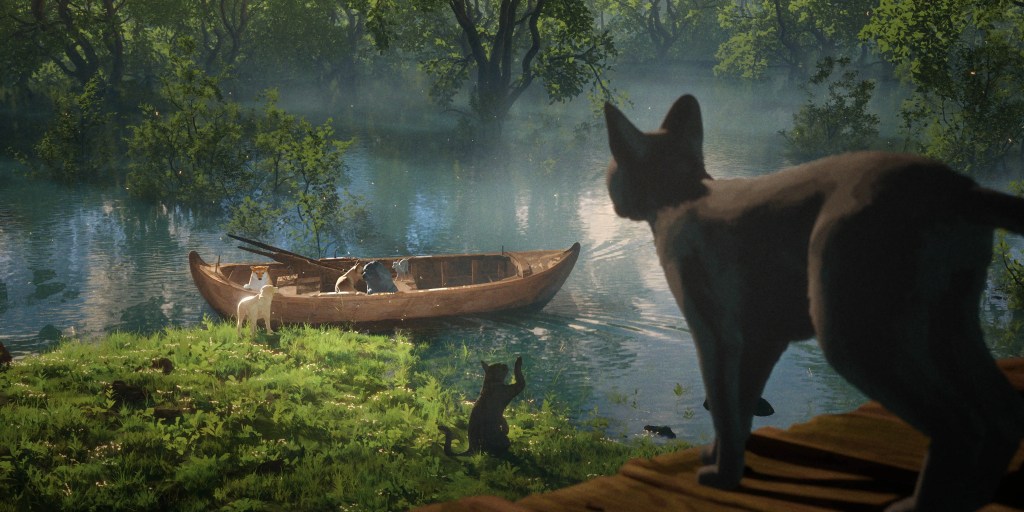
Here, they’re downright soaked, with Flow playing out as a semi-post-apocalyptic tale wherein the genesis of an all-encompassing flood is never articulated. We do know that the humans are gone, or at least out of sight when we meet our feline hero, a black cat whose actions and affectations hew closely to those of real life counterparts. Its search for dry land comes to involve a furry and feathered band of misfits, including a capybara, a ring-tailed lemur, a yellow retriever, and a secretary bird, all living in disharmony aboard a boat that sails atop ever-escalating waters. Their hunt for a new home coincides with the nascent steps of community building, observed in all its inspiring starts and disheartening stalls.
Those looking for a quicker way to identify our zoologically-inclined heroes will be hard-pressed; turns out it’s difficult to have a surname when you don’t have access to words. There’s not a single note of spoken dialogue in Flow, an ostensible storytelling hurdle that writer/director Gints Zilbalodis and his co-scribe Matīss Kaža have little trouble clearing. The events they conceive and capture have little use for verbal exchanges, powered by a visual kineticism that would make George Miller proud. Younger audiences may struggle with the absence of audible back-and-forths beyond a thoughtfully chosen squawk or meow, but Flow isn’t necessarily built for them in the first place, with sequences of action and peril more than likely to prompt a bit of seat squirm, regardless of demographic.
That the constant ambulation hits its mark is a testament to the ingenuity of everyone involved, crafting the computer-generated equivalent of a shoestring-budget indie flick. Created using the open sourced (and notably free) 3D animation tool Blender, Flow is unafraid to let the seams show, a blessed reprieve from the too-tidy manufactured worlds conjured up by American studios, themselves still adjusting in a post-Spider-Verse landscape. The hazy shading on the animals’ bodies, or the moments that seem to lapse into a sort of screensaver uncanny valley, are light detriments that prove unavoidable given the constraints on hand, but Zilbalodis has a way of moving the ‘camera’ that renders most complaints moot. A sneaky argument for the potency of the big screen, his movie’s enveloping quality, paired with the lush, tactile backdrop on which it plays out, is best witnessed on a wide canvas, where eyeballs are free to explore the comely scenery.
Sight isn’t the only sense that Flow courts with esteemable facility, as the film’s aural experience proves just as immersive. In using field recordings of all the creatures in question, the movie gains both a hard-won veracity and audience empathy, each intonation perfectly chosen to suit the moment. The same is true of the environmental sound collage, with rushing rivers and clanking rocks bellowing with a knowable force, all set to Zilbalodis and Rihards Zaļupe’s resplendent score. All that precision and attention to detail makes the moments of heightened anthropomorphism lightly disheartening, the beasts contorting to human traits that the movie has otherwise been so careful to avoid. Maybe they just needed to bring the Orwell comparison full-circle.
Totalitarianism isn’t the subject here, as absent from the proceedings as any other form of government. Flow instead trains its focus on disparate communities, juxtaposing the customs and priorities of a number of civilizations against one another. Rather than driving home a trite message of togetherness, Zilbalodis simply observes the growing pains of gaps being forcibly bridged, acknowledging the benefits of a open minded comradery without ever losing sight of what one social microcosm loses by letting another impede on its insular identity. In espousing the value of solidarity within coteries, he flips the standard animals-as-humans set up on its head, suggesting that there’s always a loser or two when everyone gets together to hold hands. A far less didactic tale than any of its forebears, Flow sees the beauty and hardship of uniting under the big tent, and if its message is a bit too knotty to land on a 7th grade syllabus, its curiosity and panoramic perspective is worth the trouble. Bonds built in relative isolation can be just as strong as those forged in a wider context, and should be defended just as zealously.
 Sherwood Likes to Watch
Leave a comment