It may feel like a new-fangled issue, but concerns about ethical depiction have existed since the dawn of cinema, with reasonable minds differing in dramatic fashion. The argument’s nascent battleground regarded war films, with heavyweights like Steven Spielburg and François Truffaut landing on diametrically opposed sides of the aisle, though it’s broadened out to include topics like race, sexuality, and violence. Whether it’s possible to create images and narratives without inherently valorizing them is an open-ended question that won’t be closing anytime soon, one presently amplified by both advocates for trigger warnings, and their detractors. Evil is a tragic, intractable fact of life, and its on screen representation comes with a vanishingly thin line between interrogation and titillation. It’s hard to know where the line is if you don’t risk crossing it, and Pascal Plante isn’t one to let good taste stand in his way.
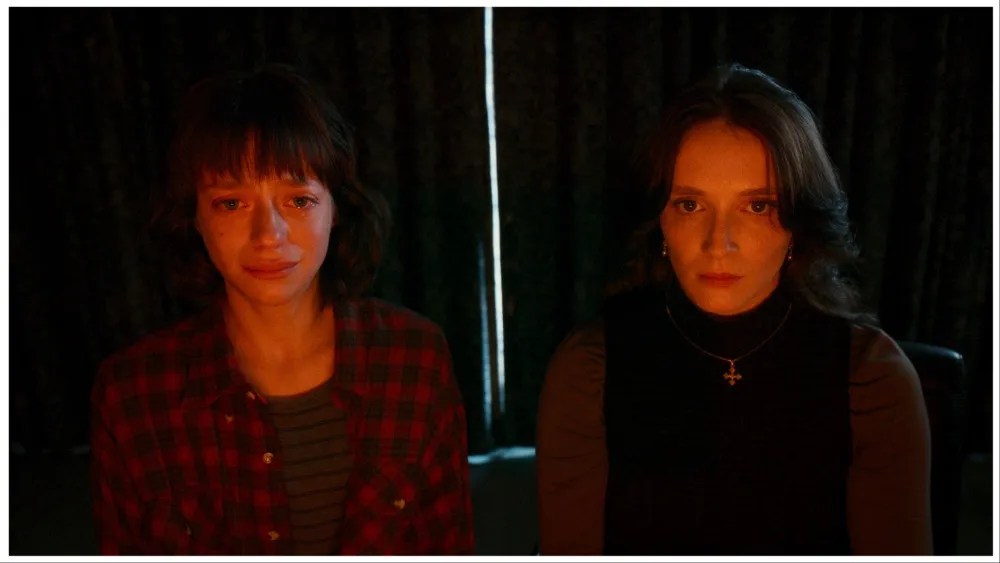
Neither is Kelly-Anne (Juliette Gariépy), Red Rooms’ fashion-modeling, online-gambling protagonist, though those pursuits seem to have grown stale. Like so many others, she’s taken an interest in true crime, an obsession that leads her to a gallery seat for the most high profile case in Montreal’s recent history. It concerns the capture, torture, violation, murder, and dismemberment of three local teenaged girls, their grisly demise captured on video and sold online in the titular chat rooms. On trial for these atrocities is Ludovic Chevalier (Maxwell McCabe-Lokos), whose myriad ties to the horrors have the furious masses calling for blood, despite the balaclava worn in the incendiary footage masking the killer’s true identity. Justice may be top of mind for the case’s innumerable onlookers, but Kelly-Anne’s source of intrigue is far more difficult to parse.
Arranging a narrative around an enigmatic protagonist is a thorny endeavor, purposely keeping your audience at arm’s length while they feebly search for footing. There’s a reason most characters with clandestine motivations approach stories from the sidelines, and Kelly-Anne operates like a supporting player unwittingly thrust into the spotlight. Plante’s harrowing briarpatch of a screenplay has plenty of revelations waiting in the wings, but we’d have checked out long before their arrival with a less compelling thespian in the central role. Gariépy is a transfixing actor, capable of emitting intelligence, resolve, and deviousness without the aid of exposition, Kelly-Anne spending much of the runtime going about her day in complete silence.
The true marvel of her performance is the clarity she finds while keeping the viewer at bay, a magic trick that must be seen to be believed. Even if her inner workings remain shrouded in shadow, you never get the feeling that the character is simply grasping at straws. This is undoubtedly a product of a film that knows precisely where it’s going, but Gariépy has to sell us on Kelly-Anne’s nebulous intentionality while we wait for the next shoe to drop with baited breath. Saving all your Voilas for the home stretch only works when your movie’s compelling enough on the ascent, and Gariépy’s deceitfully prepossessing turn is more than enough to keep us glued. A more traditional, optimistic movie would gesture toward some form of altruistic undergirding, a heroine in disguise with cards held closely to the chest. In the overwhelming darkness of Red Rooms, light of this kind can find no purchase.
Subsumed in dour greys and a pitch black worldview, Plante’s film almost necessitates comparisons to David Fincher on both technical and thematic levels. Cinematographer Vincent Biron paints with harsh angles and oppressive symmetry, the skyscrapers of the Canadian metropolis glowering down from on high like a pack of angry gods. The brooding, ambient score, composed by Plante’s brother, Dominique, is no less threatening for its station in the background, coaxing goosebumps down your spine before you’ve even acknowledged its presence. That cold sweat will be familiar to fans of Se7en and Zodiac, but the ideological concerns here are more aligned with another pair of the American auteur’s most debased outings.
The first is Gone Girl, with which Red Rooms shares an interest in media vampirism, and the stomach-turning ways it spirals out into the general population. Even in a scene as appalling as the one Plante lays out here, it’s immediately plausible that local networks and virtue-signalling rubberneckers would have a field day, extolling their pristine morality through vociferous condemnation while quietly checking their mentions. It’s the other side of the coin that proves more distinct, made manifest with the arrival of Clementine (Laurie Babin) in the early goings. Having hitchhiked in to support Chevalier from a chair next to Kelly-Anne’s, the young woman’s iron-clad belief in the innocence of the accused comes with its own type of self-flattering, soap box piety, though the primary allure of her stance might be its positioning relative to the current. By neglecting the bird’s eye view and honing in on a lonely individual, Plante achieves cinema’s most thorough examination of conspiracy culture since its global return to prominence, observing the seductive nature of going against the grain, casting yourself as the solitary wolf in an endless pasture of sheeple.
This dusky rendering of insidious, subconscious thought turns Red Rooms into a spiritual successor to Fincher’s erstwhile Netflix series Mindhunter. Its two-season run harbored a similar affinity for the minutiae of process and the fine-grain details of sleuthing, but the more prevalent kinship is in their overbearing sense of menace. Doom is fused to every frame, though the viscera is kept to a minimum, with the abominable footage that drives much of the movie’s plot kept leeringly out of sight. We do hear it though, and Plante’s determination that our imagination is more hideous than anything he could capture on screen is wise as it is malevolent. We’re all well-trained in voyeurism by now, and all it takes is a tiny shove for morbid ideation to take hold.
Less fortunate are the jury members, who are forced to watch the tapes in their entirety, a flight of demonic fancy whose incredulity is far from alone in Red Rooms’ third act. If Plante is hedging his bets, giving his audience something salacious and tactile as a reward for sitting through the sludgy, ruminative core of his film, it’s a losing wager. The maniacal tumult is at odds with the enveloping portance of everything that’s come before, but maybe the director couldn’t find another pathway to the breathtaking savagery of the climactic set pieces. Defined by mortifying stillness rather than kinetic bluster, Kelly-Anne’s final courtroom appearance, when paired with the places she ends up thereafter, are nightmare fuel of the highest order, the thudding of a draconian gavel that drowns out nitpicks and second guessing in its thunderous echo.
Whether the ends justify the means is up to the individual, just as it’s always been. Plante’s mastery of tone and conceptual rigor are less debateable, the temple of doom he’s erected boasting of innumerable trap doors and hidden hallways into the malicious unknown. His sincerity is also unquestionable, with Red Rooms’ overarching devotion to darkness leading us places that most films prove reluctant to visit. This is not 8mm or Longlegs, movies that walk right up to the edge before turning back toward more well-trodden ground. Plante jumps right off the cliff, and if that doesn’t sound like your cup of tea, rest assured that it is not. Red Rooms is that rarest of things; a picture that promises genuine danger, and then follows through on its threat. Tread carefully.
 Sherwood Likes to Watch
Leave a comment