When it comes to horror, the scare is the thing, and don’t let anyone tell you otherwise. Rest assured, they will try, extolling the virtues of proper screenwriting, captivating performances, and metaphorical intrigue as worthy signifiers of accomplishment. Those totems of sturdy construction, indispensable throughout the rest of cinema, are merely appendages in the terror genre, extensions on a house that needs to stand in its own right before considering expansion. For all the praise that Hereditary, The VVitch, Get Out, and the rest of their ilk have received as torchbearers of the ‘elevated horror’ movement, they would all cease to function without their pulse-pounding sense of dread, the built-up tension released through jittery shocks and frightening imagery. Writer/director Damian McCarthy knows this all too well, with his sophomore feature, Oddity, foregrounding its spooky sights and sounds until all else recedes into the middle distance.
You know he’s on one from the start, the movie opening with a prologue that sees a woman named Dani (Carolyn Bracken) under threat of home invasion in the dead of night. We’re still catching our breath when the film jumps a year into the future, with Dani’s now-widowered husband Ted (Gwilym Lee) paying a visit to his slain lover’s identical twin sister Darcy (also Bracken). Overseeing an occult antique shop bequeathed by her late mother, Darcy’s familiarity with the supernatural world is laughable to her pragmatic brother-in-law, who’s job as a psychiatrist makes him skeptical of her psychological well-being. He ought to be worried about his own, as the recovery of a crime-scene artifact sets Darcy on a quest to uncover the truth, no matter the cost.
The murder, supposedly perpetrated by a recently released patient at Ted’s mental hospital, is of course more than meets the eye, but the perpetrator notably doesn’t draw their power from Darcy’s side of the ledger. While Oddity is mostly comfortable culling from the dense, familiar playbook of horror’s past, its reticence to conflate real-world acts of violence with its protagnonist’s mysticism is novel. Rather than employing the movie’s demonic undergirding as an omnipotent settler of scores, McCarthy’s script reconfigures them as tools to be wielded by Darcy and Darcy alone, never acting of their own accord. Much like the instrument that bludgeoned poor Dani to death, they serve as weaponry dependent on their user, bridging the gap between the characters’ ostensible differences by suggesting that their divergent utensils point largely in the same direction.
It’s the point of attack that counts, a lesson that Oddity’s curious construction follows like a guiding light. In waiting nearly 20 minutes to introduce Darcy into the frame, McCarthy threatens a structural unpredictability that keeps the viewer constantly on edge, especially when he makes good on his promises. Despite largely taking place in one static location, the movie mixes and matches its character pairings in surprising ways, especially when Ted’s new paramore Yana (Caroline Menton) is unwittingly entered into the proceedings. She makes for a poor co-inhabitant of Ted’s garish estate when Darcy decides to make a surprise visit, two perfect strangers at the center of a movie that would normally use their archetypal cut outs as complementary players rather than centrifugal forces. The medium is supposed to either guide or haunt our key figures, but Oddity makes its mark by flipping a tried-and-true set up on its head.
That Yana is left alone with Darcy, a cell phone and withering disdain as her only defenses, is an error of judgement on Ted’s part, though it’s far from the only foolish choice that’s made during Oddity’s brisk 98 minute existence. The omnipresent foolishness of everyone on hand is, again, in keeping with genre traditions, but McCarthy’s fealty to his idols gets the best of him here. The tropes of idiocy and plot contrivance are jarring in a movie that’s otherwise expert at concocting suspense, letting small gasps of air out of a balloon that’s otherwise ready to pop. Even the actors seem aware of the screenplay’s reliance on empty-headed action, though that might be dolling out undue credit to a cast that struggles to meet the material. Bracken is strong, if silly, in her duel role, but Menton can’t locate anything within Yana beyond callous rich girl affectation, and Lee is simply disastrous. He may be saddled with a bum part, but a better performer could have ploughed through the script’s limitations with charm alone. Lee doesn’t have a charismatic bone in his body.
A better ensemble would have papered over some of the film’s messier elements, but as is, they shine through like a flashlight in a darkened estate. Drawing clear inspiration from the Mike Flannigan school of gothic horror by way of soap opera, cinematographer Colm Hogan struggles with Oddity’s more rudimentary sequences, lapsing into clumsy framing reminiscent of daytime television. The details get away from him, which is fitting for a movie that constantly gestures toward revelations that it has no plans on fulfilling. The sisters’ psychic connection is desperate for further refinement, though it’s Darcy’s blindness that truly sticks out. What could have been simply chalked up to character detailing is confounded by the presence of other players with impaired sight, illuminating a motif that Oddity leaves woefully unexplored. You love a movie with a condensed runtime, but one gets the feeling that some elaborative elements found themselves on the cutting room floor.
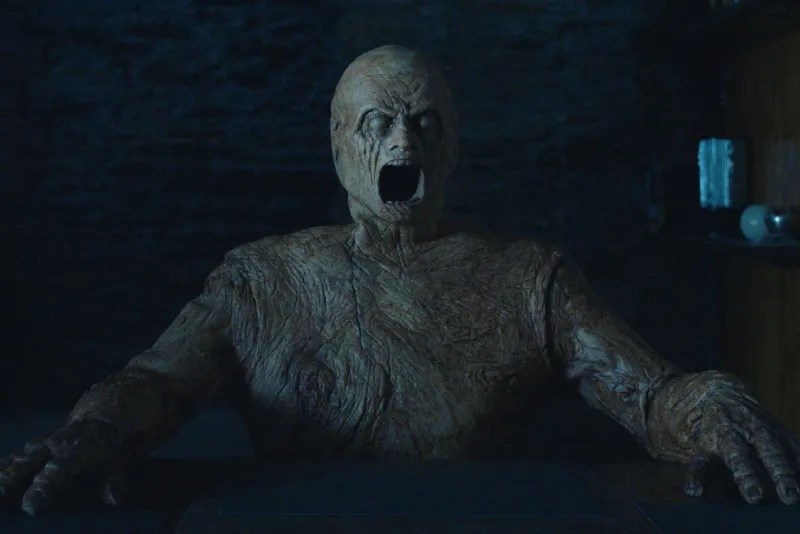
The real estate they would seemingly have occupied is instead portioned out to a revolting wooden mannequin, and it’s hard to begrudge the calculus. The implement of witchcraft, shipped to the home at Darcy’s request, sends shivers down the spine in spite of its reluctance toward movement, a truly upsetting sight in a movie full of them. Sometimes a well-chosen prop can be that important, just as an expertly conducted jump scare, especially when set to Richard G. Mitchell’s oppressively domineering score, can force other blunders down the pecking order of importance. Oddity has regrettably thin characters, graceless staging, and few duds among its call sheet. It’s also pretty damn scary, and that’s what counts.
 Sherwood Likes to Watch
Leave a comment