It’s a scenario we’ve all seen before, and the order is always the same. About 10 minutes into Longlegs, after the film has already uncorked a pair of startling opening set pieces, a young and on-the-rise FBI agent is taken out for a drink by her older, more jaded colleague. He mumbles through a weary denouncement of modern life, lightly tips his rocks glass so that the cubes gently clink, and finally orders a refill: Bourbon, because why would it ever be anything else? Buoyed by a promotional campaign that would have you believe the film is the second coming of Satan, writer/director Osgood Perkins’ fourth feature knows the serial killer playbook well, and is ever eager to not disappoint. Like the detectives at its center, the movie’s study of and familiarity with its subject matter ensure an immediate proximity to perpetrators of the past. The more data goes into the system, the more we can predict future movements.
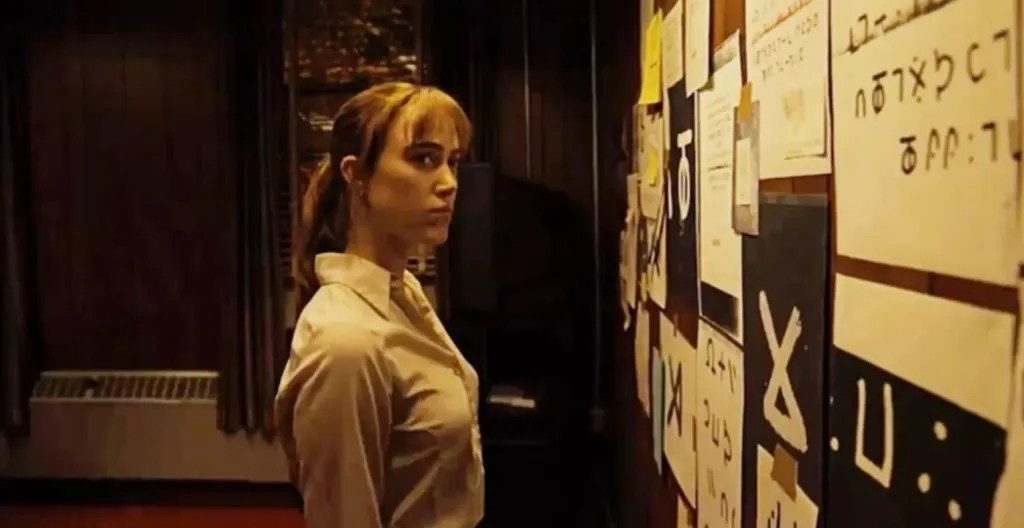
Treating the familiar archetypes in this mode of storytelling as an entrenched given, Longlegs introduces us to Agent Lee Harker (Maika Monroe), a preternaturally talented upstart affixed with an industry-standard array of eccentricities and anti-social behaviors. She’s brought on to investigate a slew of grisly murders in the film’s 1990’s rural Oregon setting, flanked by a weathered gumshoe played by Blair Underwood, the pair conducting their work under a gloomy, perfectly symmetrical skyline. Steeped in a stew of painstaking numerology and occult ephemera, Harker slowly unravels the mystery of the titular Longlegs (Nicolas Cage), and the collection of families torn asunder in his wake.
If that synopsis reads as a touch thin, it’s worth celebrating the fact that Perkins and company travel through their story as a crow flies. Clocking in at a brisk 100 minutes, Longlegs could never be accused of wasting an audience’s time, moving from one crackerjack scene to the next without the hindrance of side quests or unnecessary elaboration. It’s a lean scaring machine, and the moments that aim to send chills down spines are mostly effective, including the aforementioned one-two punch that greets us as soon as the lights dim, a steady, leering flashback and an initial probe gone wrong. They prime us for a movie that’s at once rollicking and anxiety inducing, though our guides prove just as pre-packaged as the enterprise writ large.
Monroe’s horror bonafides are not to be doubted, having toplined the modern classic It Follows as well as 2022’s well-reviewed Watcher, those films serving as modern updates to Invasion of the Body Snatchers and Rear Window, respectively. Longlegs fancies itself as a newfangled Silence of the Lambs, and while there are certainly worse cues to take, one wishes Monroe wasn’t borrowing from Jodie Foster’s Clarice Starling quite so liberally. The same could be said of Underwood, who carries a believable defeated grace that will likely hit differently for those who’ve somehow managed to miss Morgan Freeman’s turn in Se7en. The ace in the movie’s hole is Cage, caked in prosthetics to the point of being unrecognizable, though his trademark showmanship has a way of burning straight through the mask. It’s an enjoyably gonzo performance, meted out judiciously enough to avoid overbarance, but it can’t help but break the movie’s fictive dream through sheer force of personality. It doesn’t help that employing a known actor at the center of a malicious minotaur’s maze is, again, something we’ve already seen before.
Not every movie is destined to break the wheel of conformity, and most are determined to do the opposite. Still, it’s disheartening to watch someone of Perkins’ obvious capabilities be so comfortable playing the hits, especially when his movie was advertised on the prospect of shock and scandalization. Holding a filmmaker accountable for the manner in which their work is marketed is wholly unfair, and it should be noted that Longlegs’ third act pivot resembles the kind of boundary pushing that his movie so desperately craves. It simply arrives too late, after all the pristinely sinister visual arrangements and gorey jump scares have calcified into something entirely too knowable to be genuinely upsetting. Those with a taste for this sort of thing will surely get their money’s worth; the whole affair is too deftly mounted and confidently executed to not stand above most of its contemporaries, but Perkins’ curating prowess far outweighs his creative abilities. Perhaps there’s no need to fix something that isn’t broken, but would it kill someone to order a gin and tonic?
 Sherwood Likes to Watch
Leave a comment