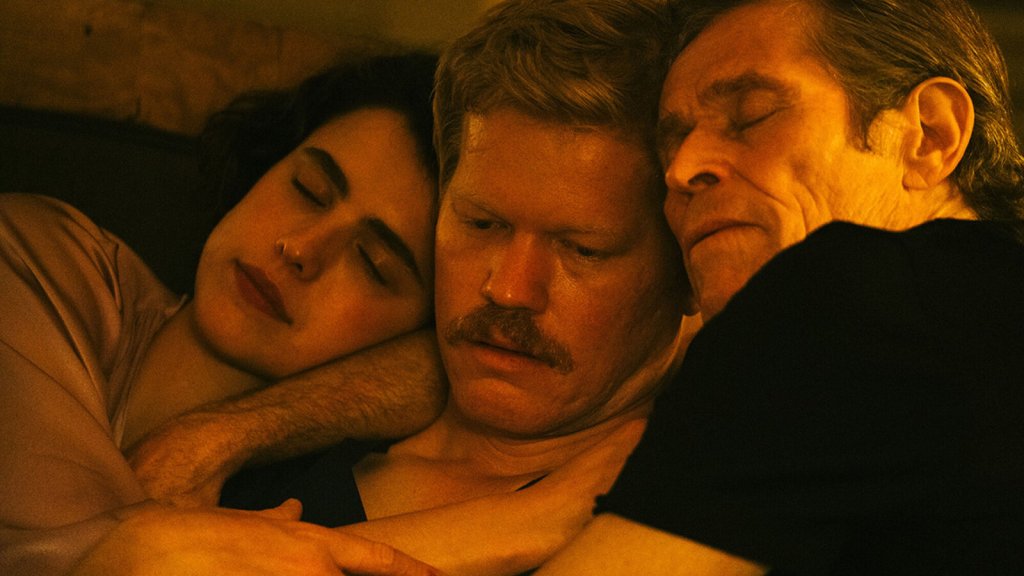
You know you’ve truly made it when people start clamoring for your previous iterations. It’s still unfathomable that the guy who made Dogtooth has become an Oscar darling, but such is the strange path of Yorgos Lanthimos’ career, a morbid Greek iconoclast refashioned stateside as an award season mainstay. Despite transitioning to English language flicks with 2015’s The Lobster, Oscar didn’t come calling until three years later, when his bleak worldview was paired counterintuitively with Tony McNamara’s verbose, politely naughty screenwriting, forging the one-of-a-kind alchemy behind The Favourite. The two reteamed for last year’s Poor Things and received similar plaudits, but the murmurs that one of world cinema’s chief proponents of cruelty might be losing his fastball grew louder with every end-of-year ceremony. As if responding to the backlash in real time, Lanthimos returns only a few months removed from this year’s Academy Awards with Kinds of Kindness, an ironically entitled rejoinder to those who’ve tired of the brightness that has infringed on his gloomy cinematic paradigm.
An anthology with only one pair of authors, Kindness sees Lanthimos reteam with Efthimis Filippou, his co-writer on all pre-Favourite features, for a trio of short films stitched together with the thematic thread of human yearning and its dastardly consequences. Opening with a segment concerning a work-life balance gone astray, the movie proceeds to touch on police work, domestic affairs, cannibalism, and the occult. Suffice it to say our guy is back in the pocket, though consciously returning to your roots isn’t the same as arriving there organically. It’s hard to fault Lanthimos for wanting to prove that he still has something nasty up his sleeve, but the efficacy of the resulting picture is in the eye of the beholder.
Aside from the unsettling subject matter, the defining aspect of the Lanthimos-Filippou union is the intentionally wooden acting style, likely a product of screenplays that are written in a second language. The pair’s cock-eyed view of the world is bolstered by the curiously flat delivery of their dialogue, an affectation mastered by Colin Farrell and Barry Keoghan in previous outings and employed again here by a stable that includes Emma Stone, Jesse Plemmons, and Willem Defoe. Judged on their individual merits, the movie’s stable of performers acclimates well, especially Defoe, but the framework on hand denies individual evaluation. With the top seven names on the cast list appearing as different characters in each story, their identities begin to blur together, an issue that would be easily avoidable with a batch of fresh faces for every new narrative. There’s no doubting their ability to shapeshift, but the rigorously applied shackles make them impossible to separate.
This is surely the point, as the recurring motifs, symbols and events across the three entries cause the isolated plots to bleed into one another in a similar fashion. From car crashes to bathrobes and continuing references to a rarely seen character known only as R.M.F., the film makes a point of corralling its disparate players under the same malevolent umbrella, each a pawn to be toyed with and torn asunder by some vindictive, omnipresent force. Idle viciousness is a catalyst for plenty of great films, Lanthimos’ early works among them, but it requires a level of interest or endearment that Kinds of Kindness lack almost entirely. Even when the aforementioned Keoghan was at his most heinous in The Killing of a Sacred Deer, there was always the feeling that the filmmakers were invested in whatever made him tick. Kindness’ characters are more like dominos patiently waiting to be knocked down in a tidy little row, a criticism that Lanthimos has always invited, but never been as worthy of as he is here.
Though the barbarous nature of early Lanthimos is and should be championed, if for no other reason than its willingness to explore areas that other filmmakers seem frightened to approach, his continued interest in the vulnerability and allure of incapacitated women has reached a breaking point. By the time it pops up again in Kindness’ closing segment, long after the audience has accepted the whole enterprise as a sort of brutish farce, it feels like the crossing of a line. Blackhearted as it may be, the movie is most coherently viewed as a comedy, an arena with no place for sexual assault, and is made more egregious by Lanthimos’ obvious affinity for the image of an unconscious female. That the violence is supposedly made more palatable because of who it’s happening to only makes it more offensive, casting a pall over the closing stretch. It doesn’t eliminate the movie’s intermittent charms, but it does illuminate the haphazard process through which they were conceived.
Lanthimos is too talented to make a genuine stinker, and the triptych format of his latest both keeps you invested throughout its elongated runtime, and ensures that there’s something for the defeatist in all of us. The first tale will appeal to those who like their riddles to have clear answers, where the climactic effort aims to charm advocates of the opaque. The middle, as its station would suggest, straddles the line, offering some conclusions while keeping other underwraps, but the tension of each neatly designed mystery box is undercut but the absence of anything resembling empathy. It’s often funny, occasionally provocative, consistently well acted and handsomely made. There’s just no curiosity, no intrigue, only tossed-off savagery that can’t be bothered to consider its real world corollaries. This one is for the haters, and if there are ever any truly good reasons to make a film, proving the discourse wrong isn’t one of them.
 Sherwood Likes to Watch
Leave a comment