It sure is fun to get all high and mighty when someone you know misunderstands the ending of The Graduate, but the joke might still be on all of us. The ensuing decades have transmogrified the final frames of Mike Nichols’ 1967 classic from a lesson in attentive viewership into a punchline brandished against the hopelessly romantic, treating film analysis as a race to the finish line of proper interpretation. With the tendency of modern filmmakers toward thematic translucence and clarity of vision, there’s an understandable inclination to appraise everything at face value, a leaning that doesn’t do a movie like Blink Twice any favors. No one wants to have gotten it wrong, especially when it comes to more incendiary subject matter, but that shouldn’t mean everything has to be exactly as it seems. Even the characters in Zoë Kravitz’s directorial debut have to reflect on their experiences to gain a greater understanding. Is a little rumination really so much to ask?
Perhaps the trigger warning that opens the film, foretelling depictions of violence, sexual and otherwise, has dampened any desire toward a fast and loose reading, though the following sequence is ripe for sleuthing. Following Frida (Naomi Ackie) as she caters a suit-and-tie affair in a New York highrise, the colors and props on hand practically cry out for literary investigation, and that’s before we meet the party’s centrifugal force, Slater King (Channing Tatum). A tech billionaire on the wrong end of an ill-defined scandal, King’s effortless charisma is too blinding a light for Frida to resist, so by the end of an evening spent meeting cute and montaging the night away, it’s no wonder she accepts an invitation to further reverie on his own private island. If everything listed above hasn’t alerted you to Blink Twice’s real life avatar, the seizure of cell phones might do the trick.
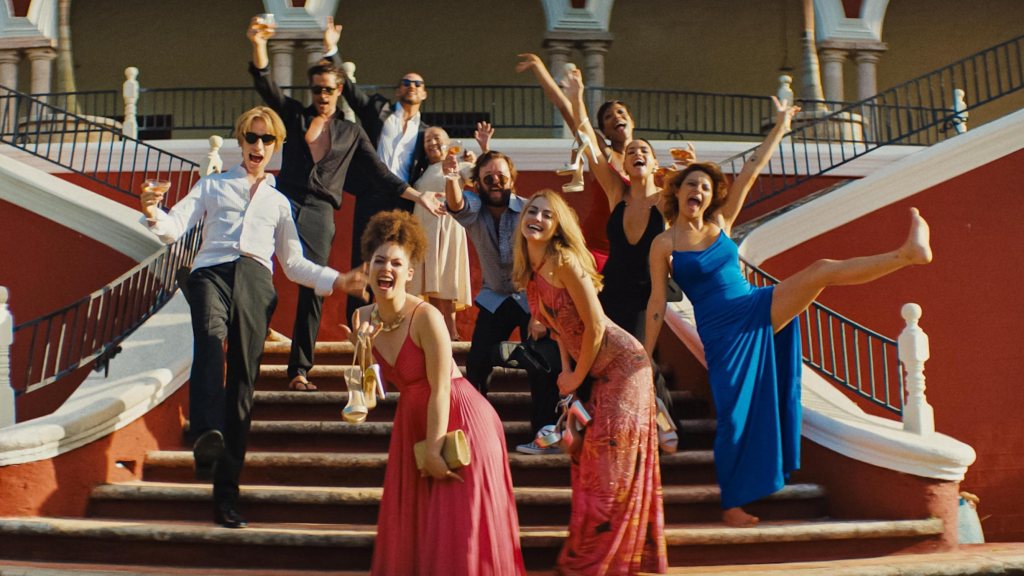
While Hollywood’s hunger for new material would suggest that every splashy headline under the sun is due for cinematic adaptation, riffing on the life and crimes of Jeffrey Epstein still feels a bit misguided. Beyond giving unwanted visual life to the atrocities, there’s precious little in the way of narrative arc or nuance, leaving Kravitz with only the initial appeal to dramatize. On this account, her movie is unassailable; from the crackerjack editing to the euphoria-inducing needle drops, there’s no ambiguity as to why an otherwise tentative person would want to RSVP. The wardrobe department is also having a ball, but the clothes and the movie at large owe their sizzle to cinematographer Adam Newport-Berra, whose hyper-saturated lensing is like a massage to the retinas. It’s simply one of the most handsome movies to see wide release in years, and an important distraction from the underdevelopment of just about everything else on hand.
Rather than corralling the plot’s freewheeling events and misdeeds into a plausible space, the screenplay, written by Kravitz and E.T. Feigenbaum, employs macguffins whenever realism proves too difficult to tackle, with invented hallucinogens and literal snake venom playing key roles in the proceedings. There’s also a willingness to refurbish successful aesthetics and motifs from cinema’s recent past that could only be seen as homage from the most charitable of audiences, with Get Out’s polaroid pictures and nighttime jaunts making an uncredited cameo, and The Wolf of Wall Street’s patented optical debauchery receiving an ‘and’ credit. These fanciful flourishes obscure the movie’s reluctance towards character development, and while the cast, which comes to include Alia Shawkat, Christian Slater, Adria Arjona, and Haley Joel Osment, gamely nourishes an environment of hedonism and excess, there’s not a single personality trait on which to grab hold.
Instead we’re treated to an endless barrage of comely montages, but if you have to cheat, it’s best to do so while strutting your stuff. The style here is so involving that the horrific elements which come to define the movie’s latter half can’t help but clash abrasively with everything that’s previously transpired, the terrifying bill at the end of the best dinner of your entire life. This is certainly intentional, but whether it’s as simple as a call to arms against society’s willingness to turn a blind eye to misogyny at its most unchecked remains unclear. There’s a chance that Kravitz’s goal here is to simply remind her viewers to be wary and repellent of the monsters that still walk among us, but something about the movie’s conclusive bookend suggests an alternative explanation.
Aside from denouncing the deviousness undergirding of the rich and the famous, Blink Twice is preoccupied with female solidarity, but whether it envisions a world bettered by its promotion or doomed to cast it aside for more immediate gains will be in the eye of the beholder. The latter translation invites a dubious form of victim blaming, so maybe it’s best leaving Kravitz’s film uninterrogated. Its creators seem to think so, too entranced with their genuinely majestic form of pazzazz to fully commit to a thesis beyond the obvious. Maybe the simplest reading is the truest, and maybe Elaine Robinson and Benjamin Braddock lived happily ever after. If history has taught us anything, it’s that we never learn our lesson anyway.
 Sherwood Likes to Watch
Leave a comment