Woe is he, the genuinely great actor forced into the mold of a movie star. Despite being in our lives for more than three decades at this point, Ryan Gosling has largely refused to take the celestial bait, keeping his memeable dreamboat status at arm’s length while affixing himself firmly to the darker corners of the cinematic landscape. For every lothario with a heart of gold (Crazy Stupid Love), there’s been a twelve-pack of psychopaths and sadsacks, running the gamut between cocaine addicts (Half Nelson), Neo-Nazi’s (The Believer) and paranoid androids (Blade Runner 2049). There’s certainly nothing wrong with following your lack of bliss, and from a certain angle, the La La Land star could be seen as the signature actor of brooding masculine tragedy since the turn of the century, but no amount of glowering has made the flip side any less tantalizing. In an era where the name on the marquee has never meant less, Gosling could just be the prince who was promised… if he ever bothered to pick up the crown.
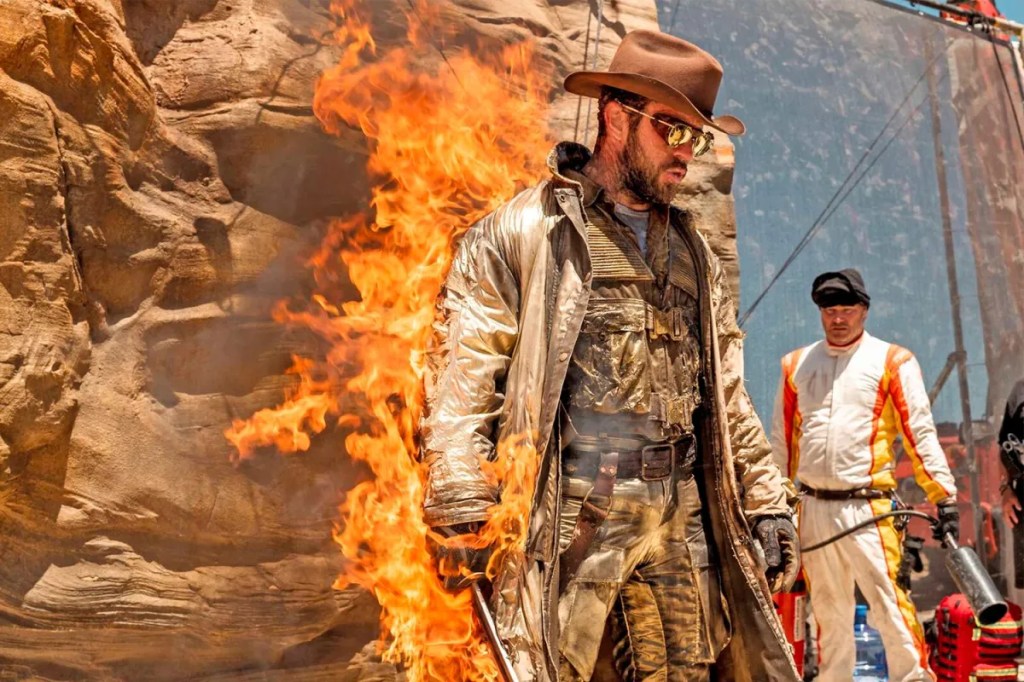
Though it might already feel like the distant past, we used to do this sort of thing all the time. Technically IP by way of a 1980’s sitcom with the same name and premise, The Fall Guy isn’t brand extension so much as an excuse to see just how brightly Gosling’s post-Barbie star can shine when given freedom to rome. He plays the majestically-named Cole Seavers, a tent pole stunt man whose brief, swoony dalliance with director Jody Moreno (Emily Blunt) is cut short by injury in the flick’s opening passage. It’s just when he’s out that they pull Seavers back in, a second chance that soon reveals itself as a new type of doubling work when his efficacy as a day player smoothly transitions into action movie pyrotechnics both before and after someone yells cut.
Negotiating the gap between The Fall Guy’s depiction of filmmaking and its equally extravagant ‘real world’ scenarios is no easy task when you’ve pitched your film with the tonal fervor that director David Leich has chosen here, which is perhaps why the entire enterprise is presented with a sort of winking remove. The movie’s metatextual interests are as surprising as they are fleeting, employing voice-over narration and fourth-wall shenanigans when it suits the momentum, and dropping them just as quickly. It’s cleverness without commitment, and while Drew Pearce’s script deserves credit for dreaming bigger than your average blockbuster, the tinsel town commentary emerges as only partially baked, resulting in a renewed appreciation for movies like Adaptation. and The Player, whose devotion to their respective bits never wavered.
This sense of half-measures is pervasive throughout The Fall Guy’s runtime, perhaps most prominently in the action sequences. While Leich, a former stuntman who’s since made a name for himself behind the camera with the likes of John Wick and Bullet Train, is no slouch when it comes to kinetic carnage, his would-be love letter to DIY ethos contains a distressing amount of CGI. For every hard bitten car crash there are two sweatless processessions of digital excess, reducing our investment in the film’s over-arching celebration of spectacle done the hard way. It doesn’t help that the movie within the movie feels tossed off at best, a Dune-coded clunker whose synthetic setting and abhorrent costumes appear intentionally parodic, undercutting the efforts of characters whose work we’re supposed to be championing. For all the insistence that Jody is some sort of visionary, her flick sure looks like a turkey.
Moreno’s laughably gaudy craftsmanship isn’t the only area where the film’s co-lead is lacking, with Blunt underplaying her every line to the point of inertia. Her motivations prove similarly hazy, with the grudge she holds against Seavers functioning far more effectively as a plot device than a character trait. Blunt’s much-hyped chemistry with Gosling wasn’t a lie, but does require true fealty to straight-man under-selling in the face of her partner’s more antic performance style, morphing into a wall for the movie’s true star to bounce his ball against. The other actors on hand follow suit, Winston Duke’s unmissable charm only occasionally finding a place to shine, while Aaron Taylor-Johnson’s excellent Matthew McConaughey impression barely sees the light of day. Only Hannah Waddingham’s Diet Coke chugging producer seems to have missed the memo, and while bravely refusing to get out of the way is commendable, it’s easy to see why everyone else is so keen on letting the top line talent cook.
There’s simply no overstating the magnificence of Gosling when he decides to simply have fun. Sharpening his dual gifts of physical grace and comic intuition until they’re capable of slicing through any nonsense a movie like The Fall Guy might put in his way, he’s the rare actor who doesn’t need to undermine the material to take audiences along for the ride. Despite spending years contorting himself into a modern day De Niro, Gosling’s truest point of comparison is Gene Kelly, an elegant goofball with enough joyous magnetism to pierce through the screen, capable of somehow landing a late-breaking monologue about feelings, purpose and love despite all the irony that’s come before. It takes hundreds of hours, thousands of people, and millions of dollars to make a movie at this scale, yet it’s still possible for one person to turn a bad movie into a good one through pure charm and force of will. Gosling is that powerful, and while we can hold our collective breaths that he finds material that’s better suited to his considerable aptitudes next time, there’s no guarantee that Movie Star Gosling will come back around anytime soon. Better catch it while it’s here.
 Sherwood Likes to Watch
Leave a comment