Having sympathy for the devil might have once been a subversive zag; by now, it’s something like a prerequisite. Anti-heroes existed long before Tony Soprano swore and sighed his way into our lives, but the affordance of basic human consideration to ostensible villains was always seen as a brave choice, a paradigm shift that turned Taxi Driver, All About Eve, and M into rebellious, time-worn classics. Unfettered heroism is seemingly too passé now, forcing movies that still have the itch to reclaim and venerate our beloved dastardly doers to broaden their search for archetypes who have yet to be refashioned with empathy’s golden paintbrush. Now that murderers, adulterers and thieves have all had their day, it’s up to Problemista to redefine how we consider one of society’s most maligned modern day players: the dreaded Karen.
Presented as a pair of demonic red eyes leering from the depths of a dark cave, the specter of this regrettable specimen hangs over writer/director Julio Torres’ debut feature from the opening prologue, a fairy tale interlude set in El Salvador featuring a young boy with big dreams, and a mother who warns him of the dangers that await in the larger world. It’s no reckless heeding; flash forward some twenty years, and New York is in the middle of eating that same kid alive. Having immigrated to the big apple with dreams of working for Hasboro as a toy designer, Alejandro (played by Torres) quickly loses his job at a fledgling cryogenics facility. Risking immediate deportation, a chance encounter with Elizabeth (Tilda Swinton), a harried whirlwind of a person who would most charitably be described as eccentric, provides hope of sponsorship. He’ll have to survive first.
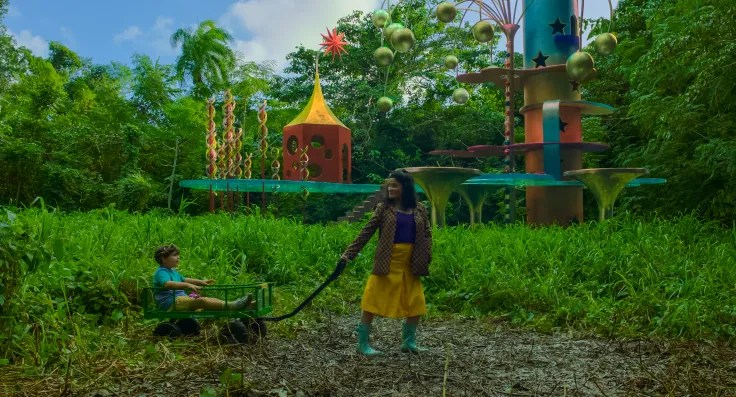
Describing the stakes of Problemista in mortal terms is perhaps a little rich when you find out that Alejandro’s primary assignment is finding a gallery for Elizabeth to display her husband’s art work, but the modesty of the task is indicative of the movie’s small scale. Largely a two-hander between Torres and Swinton, the flick follows a pair of lost souls making mountains out of molehills, and the juxtaposition of their dire attitudes against an oblivious world gives the entire operation a humorous underpinning. It’s also clearly the product of budgetary restrictions, which relegate the film’s flights of magical realist fantasy to a few fleeting moments. Problemista is at its best when letting its freak flag fly, especially in visual terms, but the moments of indelible imagery are fewer and further between than everyone involved would like you to notice, leaning on Lia Ouyang Rusli’s whimsical, winning score to convince the audience that something mystical is afoot. Torres and company are good at stretching resources, but one wishes there was a little more change for them under those couch cushions.
Perhaps a formidable amount of the bottom line went Swinton’s way, as it’s rare to see an actor of her international acclaim work with such an unseasoned filmmaker; if payment were based on effort alone, she’d be worth every penny. The safety isn’t off so much as fully removed, with Swinton swinging and sweating her way through the proceedings, her red wig tousled and her racoon eyes round as moons. When shot in profile, she gives off the distinct aroma of SNL parody, a blustering, bloviating caricature of the privileged white female designed to make the in-house audience howl. Her close-ups are more finely tuned, capturing a desperate, feral gaze that Torres can’t help but shrink from. Comprised of impotent gestures and nebbish affectations, Torres’ performance can’t help but be blown off the screen, which is undoubtedly the point, but it’s hard to root for a hero who’s so grievously over-matched in almost every scene.
It doesn’t help that the movie is so cheeky about his artistic ambitions, as the tiny interstitials that display prototypes of Alejandro’s work make clear that his dreams far outweigh his abilities. They’re good for a laugh or two, but undercut what is otherwise a welcomely earnest tale with a sense of sneering dismissal, made all the more confusing when paired with the aforementioned art work of Elizabeth’s partner. Bobby, played by a daffy and game RZA, only paints eggs, featured in various locations and come-hither poses, and though there’s something moving about his motivations (eggs as the manifestation of possibility), his creations are nothing more than another joke. The monologues about passion, drive, and imaginative kinship that unfurl throughout Problemista’s closing chapters can’t help but fall flat when the movie has aggressively clarified that no one here has the goods.
True talent or insight are not requirements for having your voice heard, as Elizabeth proves in nearly every scene, even offering sage wisdom on what to do when it feels like no one is listening. It’s intriguing to turn her relentless egomania into a sort of rallying cry, though it’s difficult to imagine Alejandro utilizing her tactics with much efficacy. The ostensible lesson on self-advocacy rings a bit hollow when our protagonist’s main problems are his skin tone and nationality, and one wonders if Torres’ screenplay is missing a little connective tissue that could have equated the plights of his lead characters more lucidly. Here’s hoping he gets there next time, because if the gonzo ending of Problemista proves anything, it’s that this kid might have the juice that Elizabeth and Alejandro so desperately lack. A few more rough drafts and a few more dollars and we might have something here. After all, he’s still just an egg.
 Sherwood Likes to Watch
Leave a comment