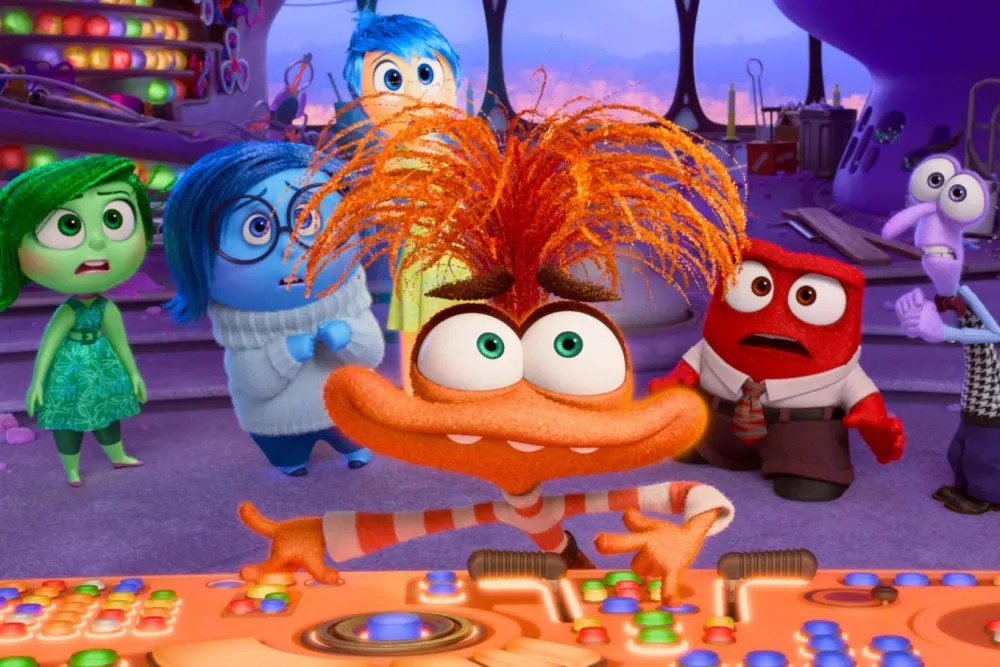
For a movie all about the ways that core emotions govern our thoughts and actions, Inside Out was decidedly left-brained. Charting the inner-workings of a twelve-year-old girl whose world is thrown into relative chaos by a move halfway across the country, the 2014 instant classic arrived at the same ugly cry finale as almost all of Pixar’s best. It even employed their signature lost-heroes-on-an-adventure playbook to get there, but the rigorous undergirding was a new look. With enough in-world rules and interconnections to befit a sci-fi flick, Pete Doctor’s film proved deeply methodical, a pain-stakingly build contraption of cause-and-effect that, while more than capable of prompting tear ducts to smart, was most admirable for its feats of ingenuity, durability, and process. Most sequels exist to extend the fictional lives of the friends we made along the way; Inside Out 2 is more interested in the way itself.
The aforementioned path has changed a bit since we last saw Riley (Kensington Tallman), with two years having transpired, and our literal headcase on the brink of entering high school. She’s also developed a sense of self, embodied in the form of a glowing orb that Joy (Amy Poehler) attends to with her typical authoritarian care. This relative stasis is interrupted by the onset of puberty, and with it the introduction of a slew of new emotions, most notably Anxiety (Maya Hawke). Another road trip through the human psyche ensues, playing out in the recesses of Riley’s mind while she spends one of summer’s final weeks at hockey camp.
If the above plot summary sounds a bit too familiar for comfort, it’s worth taking a moment to admire Anxiety as a creation. A hybrid of goofy sock puppet and waking nightmare, the character is far less antic than her simple visage might suggest, and gracefully avoidant of cheap laughs and pratfalls. Having emerged as both a buzz word and a national crisis over the last few years, especially in teen and pre-teen demographics, it’s no surprise that Pixar would seize on anxiety as the pivot point in its most psychologically inclined franchise, but the inertia with which its often depicted in popular culture is nowhere to be found. As soft-spoken and she is over-caffeinated, Anxiety acts as a catalyst rather than a hindrance, and, like Sadness in the previous film, her paradigm isn’t void of merit. Voiced by Hawke with an intonation that splits the difference between dulcet and trembling, she strikes a new chord in a movie that’s mostly concerned with playing the hits.
The other new notes are less successful, and occasionally indicative of a vanguard studio who’s somehow found itself looking to others for inspiration. A mixed media interlude in the film’s midsection coaxes its fair share of laughs, but can’t help but call to mind the Spider-Verse franchise, the new gold standard that every other American animation house seems to be chasing. Those flicks also have a firm grasp on the ‘now,’ and while Pixar shouldn’t be beholden to the sense of timelessness that its heaviest hitters have always carried, having characters describe things as ‘giving’ feels like a clumsy stab at modernity. Perhaps director Kelsey Mann and screenwriters Meg LeFauve and Dave Holstein are better suited to imitation than innovation, because the scenes of Riley at camp, while divergent from the first film in both tone and event, are a chore to watch, flatly portrayed in a way that makes you wonder if their creators are just as divested as the audience. Needless to say, Pixar won’t be making their sports movie anytime soon.
But is it so wrong to simply run it back? The unique accomplishments and failures of Inside Out 2 only stick out so much because of their sparsity in a feature that’s more of remake than continuation. The intricate lattice work of the original is sturdy enough to support such a venture, and perhaps even further exploration if the big wigs decide the payoff is handsome enough. It’s a bitter pill to swallow, that the filmmaking apparatus most associated with individuality over the past three decades is now content to recycle their own work, but that’s only the bird’s eye view. From a closer vantage point, Inside Out 2 is good because Inside Out was great, and who are we if not those who’ve come before us? If it ain’t broke, just pretend it’s new.
 Sherwood Likes to Watch
Leave a comment