For all the time we spend pouring over every famous director’s themes and preoccupations, there are precious few words uttered or written about filmmakers’ affectations. Perhaps the former qualities are simpler to parse by virtue of appearing in the text, but there’s no divorcing a Richard Linklater movie from its creator’s breezy southern charm. While an obsession with the passage of time, as evidenced in the sprawl of both Boyhood and the Before trilogy, as well as hyper-specific period pieces like Dazed and Confused and Everybody Wants Some!!, has emerged as the central talking point, the helmer’s filmography is too varied to consistently support anything like an overarching thesis. It comes and goes, but his patience and graciousness remain constant, ever the attentive host, determined to show his guests a good time. Treating earnestness and simple pleasure as non-negotiables has a way of painting most storytellers into a corner, but like the central character of his latest feature, Hit Man, Linklater has a knack for grinning his way out of a sticky situation.
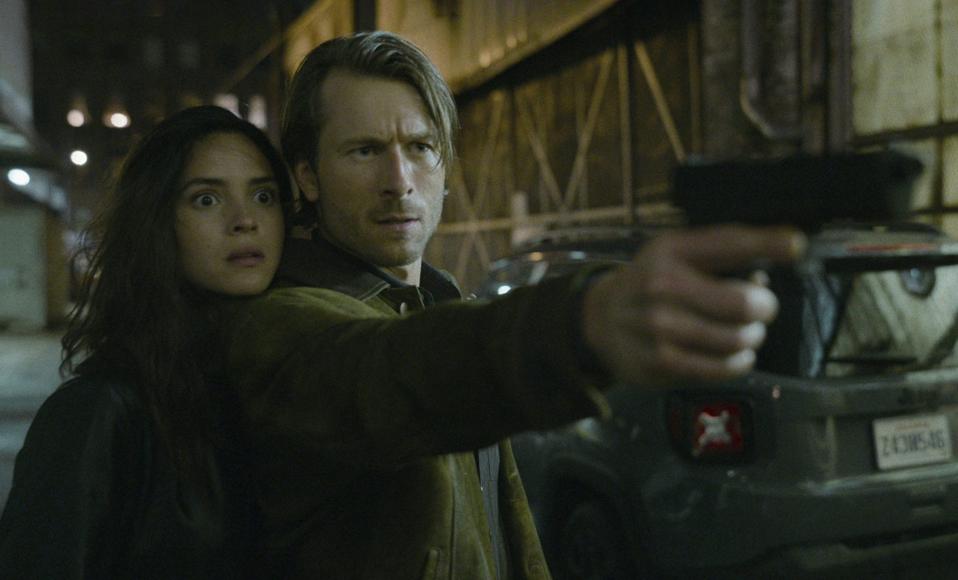
Swapping out its creator’s native Texas for a New Orleans setting that shares the Lone Star state’s gentle sunshine and easy-going swagger, Hit Man relays the (probably not) true story of Gary Johnson (played by Glen Powell), a professor of philosophy who’s reached an impasse. Adrift in a cycle of lecturing to disinterested students and eating cereal with only his cats for company, Gary’s life takes a turn when his side hustle with local law enforcement morphs into a full-time gig as an undercover detective. Disguised in various incarnations as the titular killer-for-hire, Johnson is more than up to the task of getting would-be employers to voice their intentions into a concealed microphone, quickly becoming engulfed in the sociological aspects of these cat-and-mouse interactions. Academia works wonders as a distancing factor until his services are requested by Madison (Adria Arjona), whose nuanced plight complicates his operation. Or maybe it’s just the sparkle in her eyes.
Despite being adapted from a 2001 Texas Monthly article that presented its narrative as journalism, Hit Man asks an awful lot of its audience in terms of suspending disbelief. Plot holes only matter if you notice them, but Linklater surrounds his with LED lighting and fog horns, doling out one scene of narrow escape and leaky logistics after another in a manner that’s sure to infuriate those who require a facsimile of fact in their fiction to remain engaged. The many costumes and alter-egos that Gary takes on only function as stabs at broad comedy; the smallest morsel of scrutiny reveals their deep implausibility. It doesn’t help that Powell isn’t anyone’s idea of a chameleon, his proud jaw lane and million-dollar smile making the early scenes of Johnson as a nerd in jeans shorts laughably disingenuous. We haven’t seen a dork take off the glasses and instantly become an object of desire since the 90’s, and buying into that premise has become more difficult in the subsequent years of cinematic faux-realism. Linklater’s proposition here is simple; would you like to go back?
For all the they-don’t-make-’em-like-they-used-to hand wringing that goes on in the filmic discourse, we’re mighty quick to dismiss a movie on the grounds of wonky plot machinations. Hit Man is only guilty of the exact kind of goofy inattention to detail that we now claim to miss, its yesteryear inclinations extending to its ardent belief in star power. Powell, in co-writing the screenplay with Linklater, tees himself up for a matinee idol turn and swings for the fences, and while the dress-up facets of the film’s early goings can be a bit cloying, his chemistry with Arjona is electrifying. With the Top Gun: Maverick alum already well on his way to becoming a household name, his co-star is afforded space to shine just as brightly, her effortless charisma and come-hither gaze creating a magnetic pull for Powell and the audience alike. It sounds reductive to praise a film for the mouth watering allure of its leads until you try to remember the last time two actors looked this hot at the same time. A welcome antidote to modern cinema’s aversion to sensuality, Hit Man’s sex scenes hit like breath of fresh, humid air, though the moments of clothed flirtation, wherein Powell and Arjona share the frame at the risk of catching fire, are just as likely to make a prudish viewer squirm.
Call it love or call it lust, the apple of Madison’s eye isn’t Gary, but rather Ron, the suavely-dressed, enticingly dangerous character she encounters at their first meet-up. Turns out there really are two wolves inside of Johnson, though when one is this much of a thirst trap, why not put the other out to pasture? The central question here is a juicy one, about just how much of your paradigm and outward-facing self are subject to choice, and if it’s possible to simply change your mind along the way. Despite a few college lecture scenes that push these themes into the clumsy realm of speculative exposition, Hit Man is largely content to ponder its mysteries with a toothy smile, only revealing its hidden depths upon further reflection. It’s hard to imagine a movie that’s so intellectually rigorous and foundationally dubious at the same time, all while setting your loins ablaze.
Such is the delicious concoction Linklater has brewed up here, and while it’s easy to lament the film’s Netflix release for its denial of what would have been an ideal date night out at the flicks, there’s something fitting about Hit Man being available on your own terms. After all, the best party planners aren’t pushy. They simply provide the means for a good time, and allow their guests to follow their own bliss, like Powell and Arjona sharing a banana split as the golden hour approaches. It’s somewhat unfortunate that the movie undercuts its seedy underbelly with an epilogue that’s as soft as freshly laundered sheets, but it’s also clarifying; Linklater is a gentleman entertainer, and his priority is showing you a great time, spare no expense.
 Sherwood Likes to Watch
Leave a comment