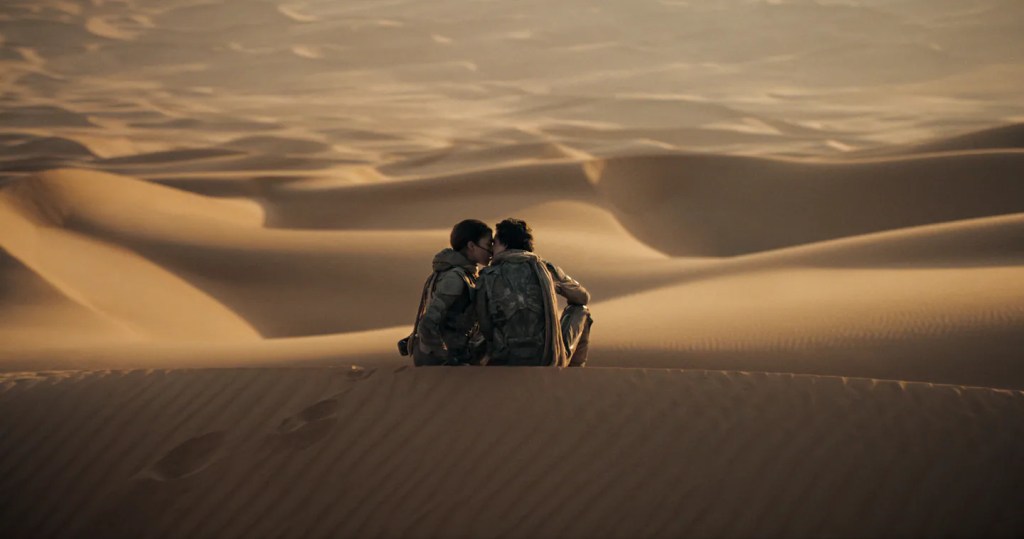
Splendor. It’s the thing we seek out most frequently when we buy a movie ticket; it’s also the quality that’s in shortest supply. Trailers have an easier go than actual features, presenting a sizzle reel of spectacular moments and images, all set to a pulsating score that rattles ear drums while retinas are set ablaze. It’s a promise that’s easier made than kept, with bloated runtimes, sloppy writing, and rushed effects work rendering nearly every blockbuster as forgettable product or serviceable brand management. Yet we keep getting duped, and not because of flashy marketing techniques or savvy trickery. Genuine tentpole wonderment is one of life’s rare cases where the juice is genuinely worth the squeeze, and for all the Marvel faceplants and less-than-Fantastic Beasts, the memories of seeing The Fellowship of the Ring or The Dark Knight for the first time are too powerful to resist the purchase of yet another cinematic lottery ticket.
If 2021’s Dune didn’t quite reach those heights, it was certainly within striking distance, and left ample enticements on the table for the continuing adventures of Paul Atreides. Concerned with mood and place more than event and kineticism, writer/director Denis Villenueve’s opening foray into Frank Herbert’s totemic novel was perhaps easier to admire than wholly adore, a product of laborious (if captivating) pacing and the expository anchor of world building. Picking up mere moments after the conclusion of the first chapter, Part 2 immediately sheds this sense of languorousness for something more fleet of foot, diving straight into an action sequence that provides the first of innumerable ‘wow’ moments. Impressed by a crew of shadowy foot soldiers floating effortlessly up a cliff side? You ain’t seen nothing yet.
The fact that epic is an overused word doesn’t make it a dirty one, and it’s nearly impossible to describe Dune: Part Two without using the big E. Having already erected his temple on the wind-swept sands of Arrakis, Villenueve and company let the spectacle flow like so much spice, ratcheting up tension and excitement through one gargantuan set piece after another. Returning below-the-line players like cinematographer Greig Fraser, editor Joe Walker and production designer Patrice Vermette all reprise their masterful work from the opening salvo, discovering new levels of shock and awe with the aid of the film’s downhill momentum. The plot machinations, concerning both palace intrigue and a burgeoning war for freedom, are almost complementary when compared to the bombastic showmanship on hand.
This overshadowing of narrative nuts and bolts is likely to cause a potential misreading, one that casts Part Two in the lineage of any number of white savior movies that it openly looks to refute. Steering straight into an idea isn’t the same as commending it, and though the film is clearly capitulating to many of the subgenre’s more insidious tropes, even a moderately attentive viewer will notice the caution signs littered throughout. Villenueve recently made headlines by telling The Times of London that he “hates dialogue,” preferring cinema to be a proponent of imagery rather than words. That the screenplay here, co-written by Jon Spaihts, refuses to literalize the breaking bad of its protagonist with clumsy verbal exchanges should be celebrated, the rare blockbuster that doesn’t mind letting the audience do a modicum of thinking for themselves.
Another inspiration for this potential misreading is the presence of its famous, cherubic leading man, and if there’s a complaint to be made about the movie, it’s that Timothée Chalamet occasionally struggles to split the difference between angelic figurehead and harbinger of doom. He might just be too modern a performer for this type of allegorical grandstanding, with his co-lead, Zendaya, also fighting off an urge toward breezy naturalism in a flick that requires its polar opposite. Everyone else on hand understands the assignment, with Rebecca Ferguson continuing her deliciously overzealous reign as our contemporary genre queen, and the likes of Stellan Skarsgård, Josh Brolin, and Charlotte Rampling providing decadent shades of darkness and light on the margins. Austin Butler must have wandered into their trailer sometime during filming, his villainous turn as Feyd-Rautha having much more to do with the theatrics of the movie’s more seasoned thespians than any of his peers. The cast’s true stand-out is Javier Bardem, picking up the series’ comic relief duties that have since been vacated by Jason Momoa, riffing on Obi-Wan Kenobi as a true believer whose potentially misplaced faith provides the movie with its weary heart.
That pulse can also be felt in the film’s attention to minutiae and oddity, displaying an aptitude for specificity that’s absent in nearly all of its theoretical brethren. Where other aspiring blockbusters prefer to elide the rules and inner workings of their given worlds, Part Two plunges into them head first, unafraid of the alienation that might come from exploring the fine grain details of fantasy and science fiction. From the tactility of thumpers and blood spinners, the marvel of inverted fireworks, and the queasy-making origin of the water of life, the movie is never less than lived-in, bearing a level of investment that can’t be faked. Turns out you can’t make an all-time classic by using half measures.
Make no mistake, that’s exactly what Dune: Part Two is; a masterwork of modern filmmaking and a new measuring stick for franchise entertainments to be judged against. It isn’t flawless, but these things never are, and over time, their minor warts become beauty marks in their own right. There’s no way that Harvey Dent wouldn’t notice the clown make-up and green hair behind the Joker’s nurse’s outfit, but that unbelievability is enchanting in its own way. ‘Fool of a Took’ is more than a little goofy, but it’s also become iconic. That’s the magic of spectacle: when fully realized, it has the power to turn bugs into features, and mercilessly steamroll nitpicks out of existence. Hand-wringing over the convenience of certain plot elements or changes to the source text will fade with time, or perhaps even be repurposed as lovable guffaws. The movie is here to stay, ready to be rewatched in perpetuity, marveled at for its feats of respendance and grandeur. We only get here about once a decade, and it will be cherished for years to come. Might as well start now.
 Sherwood Likes to Watch
Leave a comment