Alex Garland is no stranger to the ouroboros. While his obsession with organisms that eat themselves dates back to his work as both a novelist and screenwriter, the fixation fully took hold once he started directing his own scripts. His lavishly praised debut, Ex Machina, framed artificial intelligence as a creation too brilliant to not eventually bend toward desecration, while follow-up Annihilation’s final frames imply that curiosity will once again get the better of the cat. Even Men, which primarily focuses on the lesser sex as an omnipresent antagonist, includes a passage wherein consumption and regurgitation meet each other halfway. Science fiction and horror movies have always been fruitful grounds to explore mankind’s willful drive toward self-destruction, but they pale in comparison to the war genre, the cinematic mode most attuned to humanity’s limitless hunger for its own flesh. There’s no questioning the alignment of a grisly combat epic with Garland’s sensibilities, as easy to see as the risk of ensnarement in a labyrinth of his own making. The country might be devouring itself, but it’s certainly not alone.
Perhaps concerns over Civil War’s potential to be its own worst enemy were the impetus for its curious framing device, but it’s more likely that the titular North American melee is just window dressing for the film’s primary concerns. Following the road trip exploits of an unlikely quartet of war correspondents along the scenic route of American ruination, the movie loudly and insistently declares the ethics of photojournalism as its central preoccupation. Sidestepping political intrigue almost entirely is its own form of right-vs-left provocation, but it would be ungenerous to begrudge ticket buyers for feeling frustrated over Civil War’s lack of regional ideology. Those waiting to find out how exactly Texas and California could come together for a unified understanding of the greater good will have to be satisfied with implication, and even those notes are fleeting.
Without the burdensome clutter of detail and nuance, Civil War would appear to have ample real estate in which to explore its characters, but even here Garland’s pen seems to have been lost in the movie’s vacuum of specificity. Continuing his curious fascination with hollowed-out female protagonists, Garland frames Kirsten Dunst’s Lee Smith as a sun-dried husk of a human, a photojournalist whose acuity behind a camera permits her disengagement with everything on the other side of the lens. It’s not a bad character, but it certainly is an archetype, serving a specialized role in a screenplay that values utility over knowability every step of the way. Her aloof exterior is lightly pierced by Jessie (Cailee Spaeny), an aspiring young reporter that calls to mind an earlier iteration of Lee herself, though the newcomer’s innocence and personal safety are ever at risk in the presence of Joel (Wagner Moura), Lee’s amoral sidekick. What might seem like incongruous company gains clarity in the presence of Sammy (Stephen McKinley Henderson), Lee’s mentor who wears years of moral compromise right on his lapel. Where one character ends, another begins, each responding to the last like a Rube Goldberg machine doing a mediocre imitation of humanity. Even with strong performers at hand, the whole thing is too calculated to be convincing.
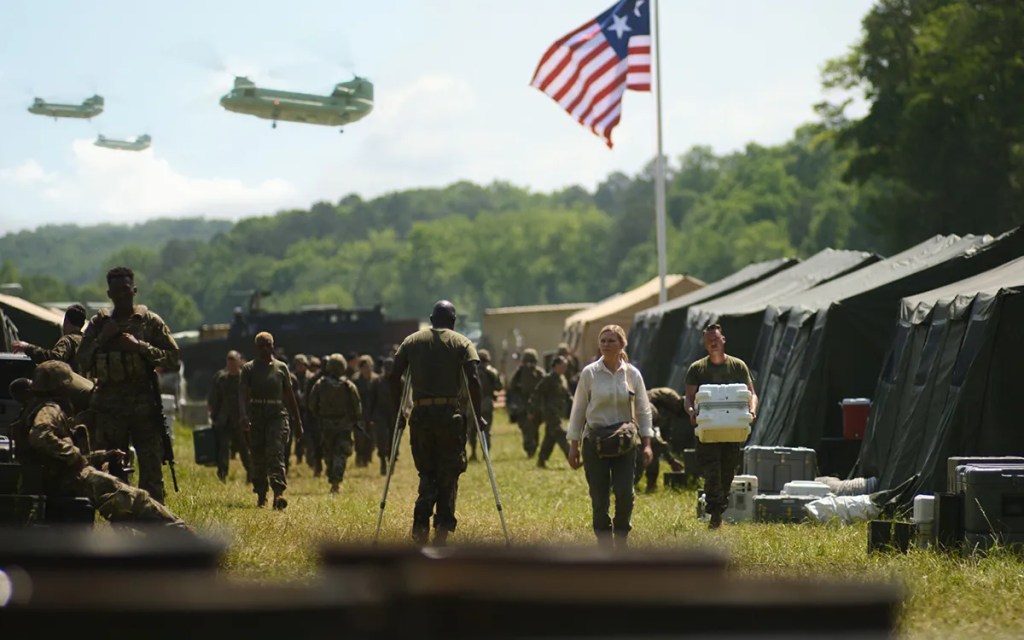
These are all left brain problems, and while that half of the mind struggles to cope with the movie’s litany of ill-conceived decisions, the right half is much more easily persuaded. Civil War might lack the analytical chops of Garland’s best work, but his filmmaking has never been more impressive, capturing war torn vistas and ratcheting up tension from scene to scene with aplomb. Cinematographer Rob Hardy frames the United States as a bliss-drenched wasteland, somehow clear eyed and hazy at the same time, while the rhythms of Jake Roberts’ editing deflate and escalate tension with the precision of a Swiss watch. From a production standpoint, the whole enterprise is nearly unimpeachable, but all that mastery only makes the final product that much more confounding.
Harrowing is a word you often hear thrown around in press releases surrounding films of Civil War’s ilk, positioning them as cautionary tales rather than escapist entertainments. It’s a clever, if thinly veiled, attempt to have it both ways, but where Garland succeeds in creating a rollicking thrill ride, he fails spectacularly as a moralist. Panoramic drone shots and De La Soul needle drops are not the tools of someone trying to warn audiences of oncoming horrors, but rather invitations to roll around in the mire. Civil War is awesome, in the same vein as an aerial skateboard trick or a face-melting guitar solo, and those open to engaging with it on those terms will find plenty to enjoy. Whether Garland’s intentions were ever loftier, or even should have been, is open for debate, but what’s undeniable is the movie’s preference for showmanship over consideration. It’s a dystopian good time at the flicks, for better and for worse.
 Sherwood Likes to Watch
Leave a comment