We were at risk of losing him for a little while there. After the award season and box office success of Call Me By Your Name, it’s hard to fault Italian maestro Luca Guadagnino for his inclination to pivot, but the seven years that have passed since his big breakout have been bumpy at best. Following up his Merchant Ivory adaptation by remaking Giallo classic Susperia was a capital C choice, and while the world of ballet and bodily trauma made for an interesting fit, there was ultimately no escaping the shadow of the original. Bones and All may have had an easier road to trek, but steered away from the director’s strengths in a way that felt almost punitive, like an orchestra conductor performing with both hands tied behind their back. Its dreary midwestern backdrop and tortured romance proved too counterintuitive to conquer, to say nothing of sloppily affixing B-movie grissle to a film with art house intentions. Testing one’s limits is an admirable pursuit, but there’s nothing wrong with playing the hits. Challengers is a hand-in-glove fit for a filmmaker of Guadagnino’s persuasion, leaving only to question whether one of our leaders in the field of indulgence is ready to reacclimate with pleasure.
Of all the sporting worlds that could be used as the setting for tawdry, sensual melodrama, tennis would seem like the most immediately well-suited, from its myriad class-signifiers to its fashion-forward combatants. With chic and sweat serving as its two-headed north star, it’s no wonder Zendaya would be attracted to the project. As much an icon of modern fashion as a movie star, her believability as a racket-wielding siren on the rise offers a comfy entry point into Challengers’ universe of love triangles and extended rallies. Operating as both the ball and the pitch on which it bounces, her Tashi Duncan provides the swivel point between frenemies Art Donaldson (Mike Faist) and Patrick Zwieg (Josh O’Conner) as the three spend years falling in and out of lust, visiting innumerable mile markers of success and failure along the way.
It really does take years. One of the more curious aspects of Justin Kuritzkes’ screenplay is its bird’s eye view of time, cross cutting between the threesome’s meeting in 2006 all the way up to a climactic match in 2019. Given the movie’s modest matinee ambitions, it’s a touch uncomfortable to watch it contort into the mold of an epic, especially when the years it’s chosen to omit provide such fertile ground for speculation. You certainly don’t watch something like Challengers in hopes of a wholly buttoned-down narrative, but the obfuscation of such lengthy periods tempt the viewer to wonder about the stretches of life with which Luca and company seem unconcerned. It also forces its three leads to play quite the array of ages, and while Faist and O’Connor acclimate with relative ease, the same cannot be said for the name on top of the poster.
The time frame isn’t the only area where Zendaya struggles, but it’s worth interrogating what the movie is offering her to play. Defined by an insatiable drive for excellence and victory, Tashi is much less a character than an idea, and one whose central identity can only exist in relation to others, sidestepping her appealing naturalism in favor of archetype. Like a handful of her contemporaries, Zendaya’s breezy knowability is a difficult match with such heightened material, and while Mia Goth’s Challengers is a decidedly different proposition, the movie could have used someone with a little more willingness to play to the cheap seats. Then again, it’s not like Kuritzkes and Guadagnino have much interest in her to begin with. Despite what all the marketing material would have you believe, this one is for the boys.
While each capable of holding the screen in their own right, it’s when Faist and O’Connor share the stage that Challengers truly takes flight, the former’s disingenuous naivety and unresolved contemptuousness juxtaposing beautifully against the latter’s self-assured, sleazy bravado. Perhaps sensing their power as a unit, the movie constantly angles to keep them apart, affording their few scenes together a gravitational pull all their own. The production itself seems titillated by their magnetism, stockpiling their sequences with hungry glances and phallic symbols until they almost burst at the seams. O’Connor, in by far the film’s juiciest part, seems to be having a hell of a time, and more so than any element outside of Trent Reznor and Atticus Ross’ throbbing electro house score, he has a firm grasp on the nature of the assignment.
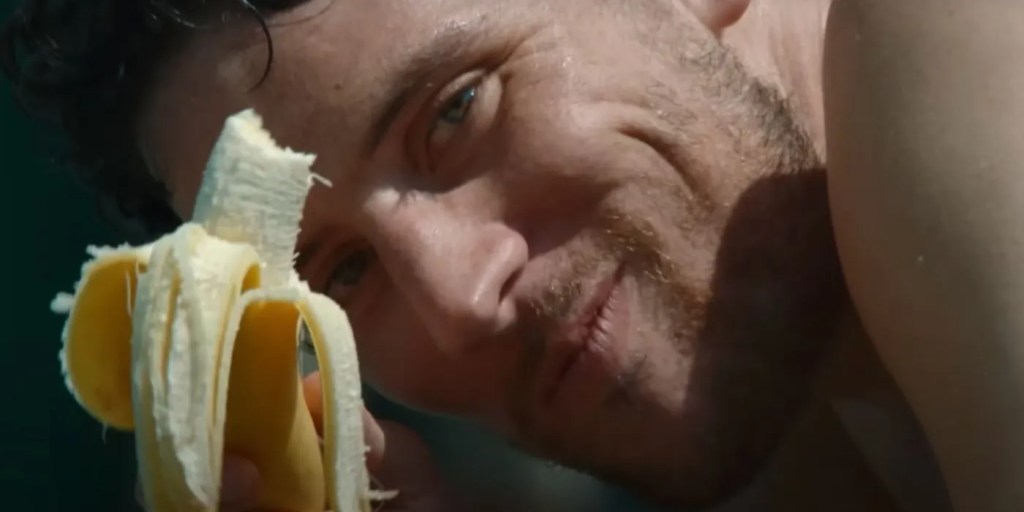
This welcome level of awareness is only sporadically shared by Guadagnino, who still seems to be shaking off the rust from his gap year(s) of misery and squalor. His sense of fashion remains exquisite, as do the period details and specific locations in which he chooses to lay his scene, but the bloated runtime and ceaseless attention to backstory don’t do the film’s pacing any favors. It also marks his second film in a row to feature attractive young stars who are defined by their physicality and sensuality to bare a notable aversion to actual coupling. We’re now almost a decade removed from Call Me By Your Name’s iconic apple imagery, and it’s worth wondering if Guadagnino has simply given into our current cinematic trend of sex scarcity, or if he and Kuritzkes believe that on-screen intercourse cheapens a film that’s dying for a more lurid touch.
Challengers is by no means a bad flick; it has too much star power, intrigue, and flair to truly fail. It’s also not a meaningful or serious one, as evidenced by its lack of detail and care for the sport it supposedly covers, with the full-tilt momentum of its climactic scene working like gangbusters in concept but falling apart almost entirely in execution. These are the signs of a romp, a movie willing to play fast and loose with rules and logic so long as the audience remains exhilarated. This one lacks that sense of devilish charm and propulsion, making it something of an odd duck, vacillating between stayed, formal drama and salacious, tasty trash without fully giving itself to either identity. Some will wish it stayed inside the lines of stately sports dramas while others will be wistful about its missed opportunities as a cinematic romance novel. Either way, it’s hard to imagine anyone being entirely satisfied.
 Sherwood Likes to Watch
Leave a comment